


Introduction
A pool can look clean at the surface while leaves and twigs collect on the floor or clog the skimmer basket. The right tool depends on where the debris is and how much has accumulated, not simply on which product is called a pool cleaner. If you’re asking what is the best pool cleaner for leaves, the practical choices in this guide range from a simple skimmer net to a manual hose-powered vacuum, a cordless leaf vacuum, or an inline canister for a suction cleaner.
Those options do different jobs. A net removes floating debris without connecting to pool plumbing, while a leaf-rake net can reach leaves on the bottom when attached to a suitable pole. A manual leaf vacuum uses a garden hose and collection bag, and a cordless vacuum runs on batteries; an inline canister captures debris carried through a suction-cleaner hose. The product information also includes a waterline cleaner and an algae treatment, neither of which is a substitute for collecting leaves.
Product Shortcode



Which Leaf-Cleaning Tool Fits the Job?
For leaves, the best match is usually a debris-collection tool suited to the location of the leaves. Floating leaves call for a skimmer net; submerged leaves call for a leaf rake or vacuum that can collect debris from the floor. If a suction-side cleaner is already part of the pool setup, an inline leaf catcher can help intercept debris in its hose path before it reaches the pool’s skimmer, pump, or filter.
That distinction matters because the options listed here are not all automatic pool cleaners. Most are manual tools or attachments, and none of the supplied product descriptions identifies a robotic cleaner. They also don’t share one installation method: some attach to a telescoping pool pole, some use a garden hose, and the canisters connect between vacuum-hose sections. Before buying, check which task you need to solve and what equipment you already have.
Start with the location and amount of debris
A small number of leaves floating on the water is a straightforward skimming job. A wide net can collect leaves, insects, and other floating debris with repeated passes, so there’s no need to connect a vacuum or run a pump for that task. If leaves have sunk, a surface skimmer net is less useful; choose a leaf rake that can reach the floor or a vacuum head designed to draw leaves into a bag.
Heavy leaf drop changes the decision because a small debris basket or bag may need frequent emptying. The U.S. Pool Supply Professional Swimming Pool Leaf Terminator Vacuum is listed with a 15-inch body and two reusable leaf bags. The Poolmaster 28300 Big Sucker is also a 15-inch manual vacuum and includes one reusable all-purpose mesh leaf bag. Those are relevant details for repeated floor pickup, though neither description establishes a specific collection capacity or a measured cleaning rate.
Match the tool to the pool surface and reach
A pole-mounted net or vacuum head requires a pole long enough to reach the area being cleaned, and the product descriptions say that poles are sold separately for several options. The POOLWHALE Pool Skimmer Leaf Rake Net is described as having a rounded frame intended for pool use and a universal holder for a standard pool pole. The Sunnyglade skimmer can be used on its own or attached to a pole, according to its description.
Pool shape also affects manual cleaning. A long handle helps reach farther from the deck, but corners, steps, and changes in floor slope can make it harder to move a wide vacuum head smoothly. The listed vacuum heads have wheels intended to help maneuver across the pool floor; the product information does not establish that they can navigate every step, drain cover, or pool contour. Move carefully near fittings and follow the tool and pool manufacturer’s guidance for the particular surface.
How the Main Options Handle Leaves
Skimmer nets for floating leaves
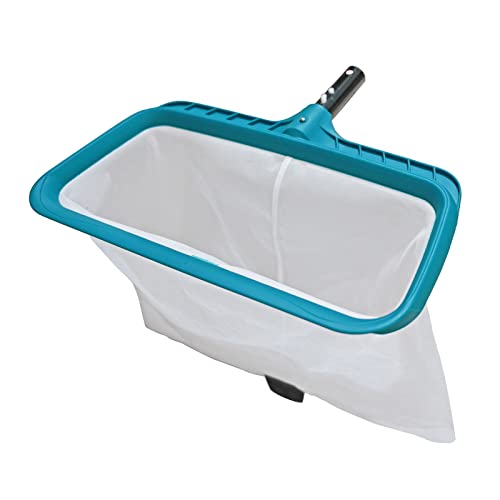
The Sunnyglade 17.5×11.8in Swimming Pool Cleaner is a plastic-framed skimmer net with mesh, listed for scooping leaves and insects from pools and other water features. Its broad frame may suit routine surface cleanup when leaves are spread over the water. The description says it can attach to a standard pole, which can extend reach from the pool deck, but a pole is not specified as included.
The Pool Skimmer Net for Leaves // Leaf Rake for Pool is also a surface net, with product details describing an inclined leading edge for lifting debris from the floor. It is listed with a universal attachment for a standard pool pole and a quick-empty tab. Those are design details to compare if bottom pickup and emptying convenience matter, but the listing’s performance language should not be read as proof that the net will collect every leaf in one pass.
A net is a simple choice when debris is visible and accessible from the surface. It doesn’t filter water, vacuum fine particles, or replace brushing and floor cleaning. Empty the mesh as needed instead of pushing a loaded net through the water, which can make it harder to control and can send captured debris back into the pool.
Leaf rakes for sunken debris
The POOLWHALE Pool Skimmer Leaf Rake Net has a deep mesh bag and a frame listed as 17 inches long, with an 11-inch width and a 14-inch-deep net. Its product details describe the frame as lightweight, with rounded borders, and say it fits a standard pool pole. A deeper bag can hold more material than a shallow net design may accommodate before emptying, although the supplied description does not give a measured capacity.
Leaf rakes are useful for reaching the floor, but technique matters. Lower the rake toward the debris and draw it through the water in a controlled pass rather than sweeping quickly and scattering leaves. A weighted lower tab is described on some nets as helping the frame settle or making it easier to empty. Rinse and inspect the mesh after use so trapped twigs and leaf fragments don’t remain in the bag.
Manual leaf vacuums for larger floor cleanups
The U.S. Pool Supply Professional Swimming Pool Leaf Terminator Vacuum and Poolmaster 28300 Big Sucker use a garden hose to create water flow through jets and draw leaves into an attached mesh bag. Each is described as having a 15-inch body and rotating wheels. The U.S. Pool Supply model includes two reusable bags and perimeter brushes, while the Poolmaster model includes one all-purpose bag and lists additional bag types as separately available.
These are manual vacuum heads rather than powered robotic cleaners. Their product descriptions call for a garden hose, a pool pole sold separately, and a bag to collect debris. As water from the hose enters the pool, the water level can rise, so account for that during longer sessions and follow the vacuum’s instructions. Because a garden-hose leaf vacuum does not rely on the pool’s suction line in the same way as a suction-side cleaner, it can be an option for owners who want to gather leaves without routing them through the circulation system.
Manual control has a tradeoff: you guide the head across the pool yourself, and the bag has to be checked and emptied when it fills. Large leaves can be easier to collect than fine dust with a mesh leaf bag, but the supplied descriptions do not state a micron rating or claim fine-particle filtration. If the main concern is sand, silt, or algae rather than leaves, confirm the filtration method needed for that material instead of assuming a leaf bag will capture it.
Cordless pickup versus inline leaf protection
The POOL BLASTER Leaf Vac Cordless Hoseless Pool Leaf is a battery-powered vacuum listed for cleaning the pool bottom or skimming the surface. Its description says it operates without a garden hose or cord, uses eight AA batteries, and is designed for up to three hours of runtime. It includes an extra-large all-purpose leaf bag and can be used by hand or attached to a standard telescoping pole, which is not included.
That combination may appeal to someone who wants a self-contained tool instead of managing a garden hose or suction hose. Check the actual cleaning plan against the listed battery and bag arrangement: repeated pickup of heavy debris may require stopping to empty the bag or replace batteries. The runtime is a product specification, not a guarantee for every use condition. Follow the manufacturer’s battery, charging, and water-use instructions, and don’t improvise electrical changes.
An inline leaf catcher serves a different purpose. The Zodiac Genuine Parts Cyclonic Leaf Catcher is described as connecting to a suction-side cleaner hose to collect leaves before they reach the skimmer, pump, or filter. The U.S. Pool Supply Pool Leaf Catcher is listed as an in-line canister for many suction, manual, and automatic cleaner hoses, with a clear body and removable mesh basket. Check hose size, cuff type, and the cleaner’s instructions before purchase; the U.S. Pool Supply listing describes a 1.5-inch hose arrangement and included adapters, not universal compatibility.
Keep Leaves Out of the Circulation System
A leaf canister can reduce how much large debris travels through the hose toward the pool’s filtration equipment, but it adds a basket that needs inspection and emptying. Place the canister as directed by its manufacturer and verify that its connections match the hose sections on your cleaner. A poor connection or a blocked basket can interfere with cleaner operation, so inspect the fittings and basket if suction appears to change.
The clear body on the U.S. Pool Supply canister makes the debris basket visible, according to the product description. That can help an owner notice when it needs attention without opening it first. The Zodiac model’s description highlights a twist-lock top and cyclonic water flow intended to keep debris moving within the canister. Those are manufacturer-described design features, not a basis for assuming the canister never clogs or needs cleaning.
Before servicing a canister or any cleaner connected to pool equipment, follow the pool and cleaner manufacturers’ shutdown and maintenance directions. Don’t open pressurized equipment or make plumbing changes while a system is operating. If you’re unsure how a suction connection should be isolated or reconnected, consult the equipment documentation or a qualified pool service provider rather than guessing.
Separate Leaf Removal from Waterline and Algae Care
Two items in the product data address pool care but don’t collect leaves. STAR BRITE Home Pool Waterline Cleaner Scum Remover is a surface-cleaning product for dirt, scum, and oily buildup, with instructions to apply it to the waterline and wipe it away. The description warns against use on printed or painted surfaces and recommends checking an inconspicuous area first. It is not a leaf vacuum, and its surface restrictions deserve attention before use.
Clorox Pool&Spa Swimming Pool Algaecide is a chemical product described for treating and preventing algae. It does not remove leaves or replace physical debris collection. Follow its label for dosing and handling, and never combine pool chemicals or apply them in a way that conflicts with label directions. Keeping debris removal, waterline cleaning, and chemical treatment as separate jobs helps prevent buying a product for the wrong problem.
Leaf accumulation can also coincide with cloudy water or visible algae, but those symptoms don’t establish that leaves caused the water problem. Remove solid debris first, then test and manage pool water using the product label and pool equipment guidance. Avoid putting a waterline cleaner or pool chemical into a leaf-catching tool unless the manufacturer explicitly directs it.
A Practical Choice for Your Pool
Choose a skimmer net for floating leaves, a deep leaf rake for reachable debris on the floor, and a manual leaf vacuum when a larger floor cleanup calls for a collection bag and garden-hose operation. The cordless POOL BLASTER option offers a separate battery-powered approach, while an inline canister is most relevant when a suction cleaner is already part of the setup and hose compatibility checks out. None of these choices should be treated as a universal substitute for the others.
For a straightforward surface-cleaning routine, the Sunnyglade net is a simple pole-compatible option; for sunken leaves, compare the deep rake and wheeled vacuum designs instead. If you want to limit leaves entering the circulation equipment, assess a compatible inline catcher and keep its basket clear. The best decision is the tool that matches where the debris collects, the reach you need, and the equipment you’re prepared to maintain.




Write Your Review
No reviews yet. Be the first to share your experience!