

Backyard hydrotherapy often seems out of reach when prospective owners face substantial estimates for electrical panel upgrades, trenching, and dedicated subpanel installations. Setting up a private spa becomes significantly more approachable when you understand exactly what is a plug and power hot tub and how standard household voltage changes the installation equation. Instead of demanding a hardwired 230-volt connection, these self-contained units operate using a standard 120-volt grounded household circuit protected by an integrated ground fault circuit interrupter (GFCI). Pairing an efficient portable tub with durable patio hot tub covers helps preserve water temperature without requiring permanent remodeling of your outdoor living space.
Many property owners appreciate that these portable units offer a balance of durable rotational molding, targeted hydrotherapy jets, and simplified site placement on flat patios or reinforced decks. While standard 15-amp power eliminates the need for expensive electrical contractor visits, owners must still evaluate important operational tradeoffs such as heater wattage and thermal recovery rates during colder months. Establishing proper water chemistry balance, regular filter maintenance, and plumbing biofilm flushes ensures your spa continues running efficiently throughout its lifespan. Exploring the core mechanics behind these convenient home spas clarifies whether a 120-volt portable model matches your personal relaxation and budget expectations.


Everything You Need to Know About Plug-and-Power Spas
A plug-and-power portable spa, widely recognized as a plug-and-play hot tub, is a self-contained hydrotherapy unit engineered to run on standard residential 110-volt or 120-volt alternating current. Unlike conventional hot tubs that demand specialized 230-volt hardwired electrical service and dedicated breaker panels, these spas connect directly to an existing outdoor electrical receptacle. This design simplifies delivery, setup, and site preparation for residential backyards, urban patios, and rental homes. Understanding the operational mechanisms, heating dynamics, and site requirements ensures you select a model that aligns with your household relaxation routine.
Electrical Infrastructure and Dedicated Circuit Requirements
The defining engineering feature of these portable spas centers on their power supply cords. Most models feature an integrated 15-amp or 20-amp power cord equipped with a built-in ground fault circuit interrupter (GFCI) pack located near the three-prong plug. This built-in breaker constantly monitors electrical current flow and instantly cuts power if a ground fault occurs, providing vital user safety in wet outdoor environments. National Electrical Code standards require plugging these units into an outdoor receptacle with a weatherproof while-in-use cover located at least six feet from the spa water edge.
A common operational mistake involves connecting a portable spa to an overloaded household branch circuit shared with patio lights or power tools. Standard 120-volt spas require a dedicated circuit with no other electrical loads to prevent nuisance breaker tripping when the water pump activates. Using light-gauge household extension cords is strictly prohibited by spa manufacturers because the resulting voltage drop can overheat wiring and damage internal pump motors. Confirming that your outdoor receptacle delivers stable household voltage ensures consistent pump operation and reliable control board performance.
The Dual-Speed Pump and Electric Heater Concurrency Tradeoff
Operating within the limits of a standard 15-amp household circuit requires specific engineering tradeoffs regarding internal component power sharing. Hardwired 230-volt spas utilize robust 4-kilowatt to 5.5-kilowatt heating elements capable of running concurrently with dual hydrotherapy pumps on high speed. In contrast, 120-volt plug-and-play spas utilize compact 1-kilowatt to 1.5-kilowatt electric heaters due to standard amperage limits. The onboard electronic control pack automatically prioritizes pump operation, temporarily disengaging the heating element whenever the user switches the pump into high-speed jet massage mode.
This sequential power management means the water temperature can drop slightly during extended hydrotherapy sessions in freezing ambient air. While the pump operates on low speed for daily filtration and circulation, the heater activates seamlessly to maintain your desired temperature setpoint. When you activate high-speed massage jets for vigorous hydrotherapy, the water relies entirely on ambient thermal retention until you finish and return the pump to low speed. Homeowners in colder regions often address this characteristic by keeping soaking sessions within thirty minutes or setting initial water temperatures slightly higher before winter use.
Shell Construction and Cabinet Engineering
Cabinet and shell construction dictates the structural durability, total dry weight, and overall portability of plug-and-power spas. Many popular models, such as the Inland 6-person hot tub by Strong Spas, utilize rotationally molded polyethylene resin rather than traditional cast acrylic backed with fiberglass. Rotomolded construction involves melting polymer granules inside a rotating heated mold to form a single seamless, impact-resistant unibody shell and exterior cabinet. This manufacturing technique produces a resilient exterior that resists cracking, chipping, and weathering without requiring periodic cabinet staining or heavy structural framing.
Because rotomolded thermoplastic shells are substantially lighter than thick cast acrylic vessels, two to three adults can readily position the empty spa onto a backyard patio. Units featuring full polyurethane foam insulation, like the Lifesmart 4-person spa, encapsulate internal plumbing lines within dense expanding foam to maximize heat retention and stabilize cabinet walls. High-density full foam also dampens operational vibrations generated by internal pump motors, producing quieter operation during evening soaking sessions. Inspecting cabinet insulation architecture helps prospective buyers anticipate winter standby thermal efficiency and overall component longevity.
Hydrotherapy Configurations and Seating Ergonomics
Jet counts on 120-volt portable spas are carefully engineered to match the volume output of single-pump hydraulic systems. While hardwired multi-pump spas may feature fifty or more jets, plug-and-play designs typically optimize between 13 and 24 strategically placed hydrotherapy nozzles. The Lifesmart 4-person spa pairs 13 hydrotherapy jets with an adjustable air control valve, allowing users to modulate massage pressure by blending air into the water stream. The Inland 6-person spa deploys 24 hydrotherapy jets driven by a 2 Peak HP two-speed pump to deliver focused lumbar and leg hydrotherapy across multiple seating positions.
Interior seating configurations vary between open barrier-free layouts and contoured bucket stations. Open bench seating permits relaxed movement and flexible guest capacity, making it convenient for entertaining family members or casual bathers. Contoured bucket seats cradle individual bathers with dedicated back support and targeted jet arrays aimed at common tension points along the spine. Selecting the ideal interior geometry depends on whether your household prioritizes social versatility or targeted post-workout muscle recovery.
Foundation Preparation and Structural Weight Calculations
Even though plug-and-power spas are marketed as portable appliances, their operating weight requires a solid, level foundation. A filled hot tub exerts substantial downward force once you factor in the empty dry weight, total water volume, and bather capacity. Water weighs approximately 8.34 pounds per gallon, meaning an average 300-gallon spa holds over 2,500 pounds of water before adding the weight of several adult occupants. Calculating your total load by summing the dry weight, filled water weight, and occupant weight divided by the footprint square footage establishes the pounds-per-square-foot load rating.
A flat poured concrete pad measuring at least four inches thick provides the most reliable foundation for long-term structural stability. Modular high-density resin spa pads placed over a properly leveled, compacted crushed gravel base offer a practical alternative that avoids pouring permanent concrete. If you plan to install a portable spa on an elevated wooden deck, consult a structural engineer or licensed builder to confirm the framing meets load requirements. Placing a filled spa on uneven ground can warp the thermoplastic cabinet, stress internal plumbing unions, and cause slow shell deformation over time.
Standby Thermal Efficiency and Cover Sealing
Because 120-volt heaters generate warmth gradually, thermal retention at the water surface plays a primary role in controlling overall power consumption. Over sixty percent of hot tub heat loss occurs directly through the water surface through evaporation and thermal radiation. Utilizing protective hot tub covers with warranty coverage provides a durable barrier against cold air infiltration while locking in accumulated warmth. A quality thermal cover features tapered high-density expanded polystyrene foam cores encased in marine-grade vinyl to facilitate rainwater runoff and resist moisture saturation.
A tight-fitting cover skirt and continuous hinge seal prevent precious warm air from escaping around the spa rim during windy weather. For compact urban patios or smaller garden spaces, choosing practical foldable hot tub covers simplifies daily handling without sacrificing perimeter insulation. Always fasten safety locking straps when the spa is unattended to protect children and prevent high winds from lifting the cover. Routine application of marine vinyl protectants shields the outer exterior from ultraviolet degradation, keeping the protective vapor barrier intact for multiple seasons.
Water Chemistry Balancing and Plumbing Line Maintenance
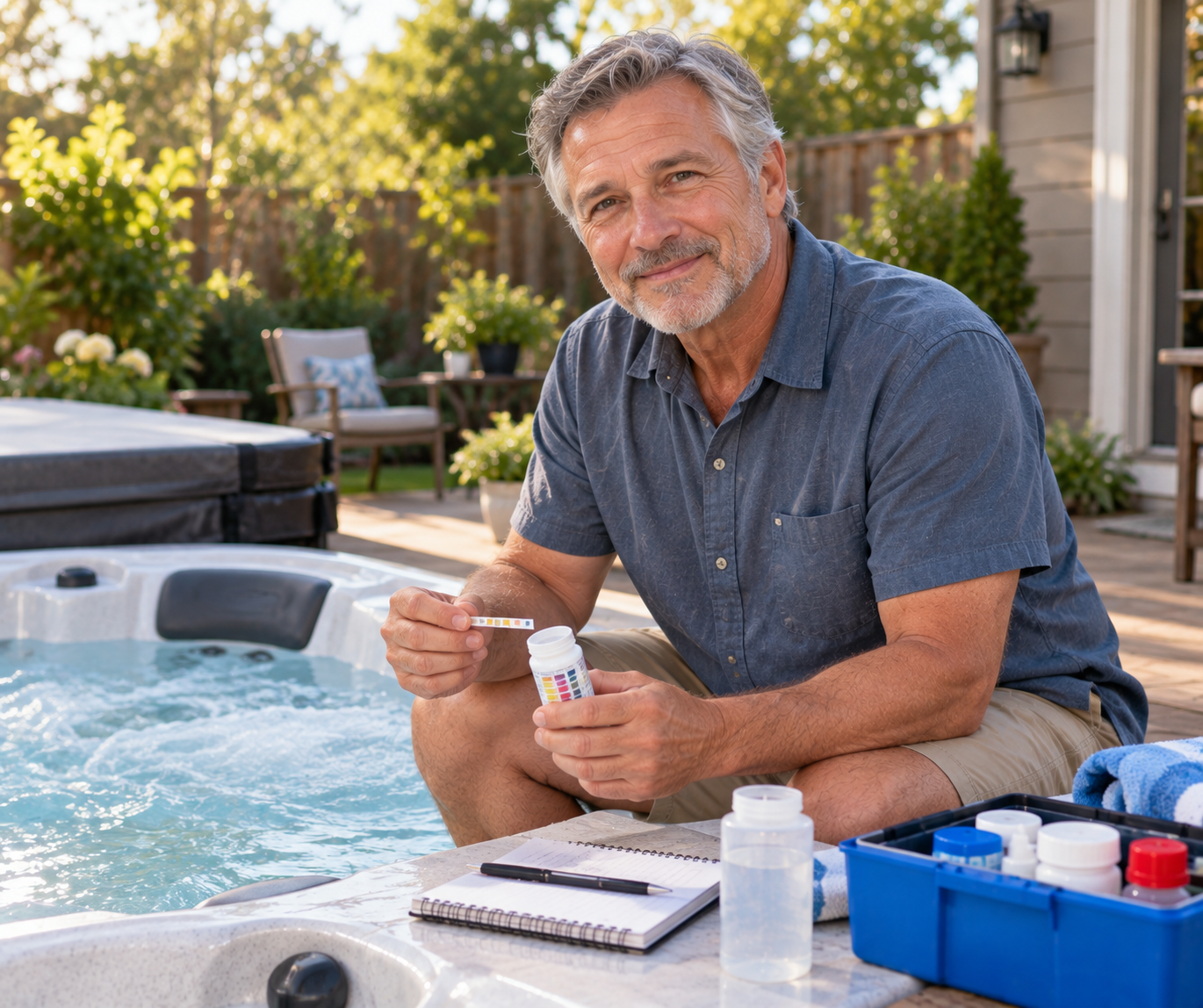
Maintaining balanced water chemistry is critical for protecting internal heating elements and keeping bathers comfortable. Spa owners should test their water weekly using reliable test strips or liquid test kits to monitor sanitizer residuals, pH, and total alkalinity. Ideal operating parameters include maintaining free chlorine between 1 and 3 parts per million (or bromine between 3 and 5 parts per million), alongside a balanced pH of 7.2 to 7.8. Keeping total alkalinity between 80 and 120 parts per million buffers pH drift, preventing acidic water conditions that corrode heater elements or high pH levels that cause mineral scaling.
Over several months of regular soaking, body oils, lotions, cosmetics, and organic residues inevitably accumulate inside hidden plumbing lines. Using specialized line cleaners, such as Bio Ouster Power Purge hot tub jet cleaner, effectively breaks down deep gunk and pipe deposits before routine water changes. Spa care guidelines recommend dosing two ounces of cleaner per 500 gallons of water and running jets on high speed for 15 to 20 minutes before draining. Wiping down the interior shell as the dirty water empties ensures loosened grime does not adhere to the surface, leaving plumbing passages clean for the fresh water refill.
Cold Weather Performance and Freeze Protection Safeguards
Operating a 120-volt portable spa during freezing winter weather requires practical awareness of heating recovery rates. Under normal conditions, a compact 1-kilowatt heater raises water temperature by approximately one to two degrees Fahrenheit per hour with the insulated cover securely closed. Most modern control packs incorporate automated freeze protection programming that engages the circulation pump when ambient sensors detect temperatures approaching freezing. This continuous water movement distributes heat throughout internal manifolds, preventing ice crystallization inside delicate pump volutes and plumbing lines.
If you live in a region experiencing severe sub-zero winters, keeping the water set to a steady standby temperature between 100 and 104 degrees Fahrenheit minimizes recovery delays. Allowing water to cool completely between uses forces the lower-wattage heater to run continuously for multiple days to reach comfortable soaking temperatures. If you decide not to use the spa during the coldest winter months, perform a thorough winterization process. Complete winterization requires blowing all residual water out of internal jet lines with a wet-dry vacuum to prevent cracked plumbing caused by frozen expansion.
Determining If a 120-Volt Spa Matches Your Lifestyle
Evaluating your household hydrotherapy preferences helps determine whether a plug-and-power spa or a hardwired 230-volt model provides the better fit. Homeowners who want straightforward installation without hiring electrical contractors or modifying their existing service panel find 120-volt models exceptionally convenient. Renters also appreciate these spas because the entire unit can be drained, unplugged, and transported when moving to a new property. The compact footprint and manageable dry weight make them particularly suitable for small backyard patios and suburban decks.
Conversely, larger households planning daily hydrotherapy sessions with multiple simultaneous bathers in cold climates might find the simultaneous heating capabilities of 230-volt systems more suitable. A hardwired spa delivers rapid reheating and continuous high-pressure massage, but it requires substantial initial electrical infrastructure investments. By weighing installation convenience, seating requirements, and winter climate demands, you can confidently invest in a portable spa that delivers reliable relaxation for years to come.
Choosing a plug-and-power hot tub provides an accessible pathway to daily hydrotherapy without the complexity of permanent electrical renovations. With proper foundation planning, diligent water balancing, and quality cover insulation, these versatile spas offer dependable comfort season after season.






Write Your Review
No reviews yet. Be the first to share your experience!