


Accurately determining spa water capacity is essential before balancing chemistry, calculating structural deck stress, or planning a fresh fill. Many new spa owners wonder exactly how many gallons of water in hot tub shells are held on average, especially when preparing to dose initial startup sanitizers or clarifiers. Guessing your spa volume often leads to severe chemical overdosing, persistent foaming, or skin irritation from out-of-balance sanitizers. A standard portable acrylic spa usually holds between 300 and 450 gallons of water, though actual volume fluctuates significantly depending on internal molded seating, footwell contours, and integrated equipment bays.
Beyond chemical maintenance, knowing your exact volume is vital for structural safety because water adds an immense amount of physical weight to any support pad or deck framing. At roughly 8.34 pounds per gallon, even a modest four-person model holding 350 gallons creates nearly 3,000 pounds of liquid weight before accounting for the shell itself or adult bathers. Pairing an accurate water measurement with a fitted outdoor patio spa cover prevents unnecessary evaporation, locks in heated water volume, and stabilizes your baseline water line across changing weather conditions. Taking time to measure your vessel accurately ensures safer water management, balanced chemical dosing, and dependable structural support throughout the life of your installation.


Pros
- Consolidates primary startup essentials including chlorine, pH balancer, clarifier, and testing into a single kit
- Fast-dissolving chlorine granules circulate quickly without requiring specialized dispenser hardware
- Helps safeguard internal heating elements and jet surfaces against scaling and corrosive water conditions
- Eliminates the guesswork and extra trips associated with purchasing individual chemical bottles piecemeal
Cons
- Configured specifically around chlorine sanitization and is not suitable for spas running bromine or alternative systems
- High-use items such as chlorine granules and test strips will deplete faster than secondary specialty balancers under heavy bather loads
- Requires careful measurement of your specific spa gallon capacity to calculate precise dosing amounts
The AquaDoc Chlorine Hot Tub Starter Kit is a comprehensive water maintenance bundle designed to take the confusion out of opening, refilling, and balancing residential spas. Tailored specifically for first-time hot tub owners, vacation rental hosts, and households performing a routine seasonal drain-and-refill, this package provides the core products needed to test, sanitize, balance, and clarify hot tub water right out of the box.
Maintaining proper hot tub water requires balancing multiple chemical parameters simultaneously to keep water safe and appealing. This starter kit integrates fast-dissolving granular chlorine to establish quick sanitizing residuals alongside essential pH and alkalinity balancers. With included testing capabilities and clarifiers, users can easily diagnose initial water quality and treat foaming, organic oils, and particulate cloudiness before they cause skin irritation or require premature water dumping.
The included chemical formulations are developed to dissolve rapidly in heated water, reducing the risk of gritty chemical sediment settling on your acrylic shell. Maintaining balanced water chemistry also serves a vital mechanical function. By keeping pH in an optimal range and managing calcium hardness, this kit helps protect expensive spa heaters, pump seals, and plumbing lines from aggressive acidic corrosion or mineral scale buildup.
Getting started requires measuring your hot tub gallon capacity to determine accurate initial dosing. Using the test supplies, you establish baseline readings for pH, alkalinity, and sanitizer levels directly from the fresh fill. Chemical additions should always be introduced one at a time with the jet pumps running and the hot tub cover removed to allow off-gassing and even circulation throughout the plumbing system.
While this bundle serves as a convenient complete startup package, it is formulated specifically around traditional chlorine sanitization and cannot be used with bromine, mineral-only, or biguanide sanitizing programs. Additionally, consumable rates vary based on bather frequency, meaning owners with heavy hot tub usage will need to restock fast-dissolving chlorine granules and test strips sooner than specialty clarifiers or cleaners.
For owners seeking a reliable, step-saving entry point into hot tub maintenance, the AquaDoc Chlorine Starter Kit delivers dependable convenience and balanced water management. It eliminates the frustration of researching and purchasing separate chemicals individually. Before buying, verify that your spa manufacturer permits granular chlorine sanitization and confirm your tub volume for accurate startup dosing.
Achieving clear hot tub water begins with balancing total alkalinity and pH before establishing a sanitizer residual. When source water enters the spa, running the circulation pump while testing gives an accurate starting baseline for necessary chemical adjustments.
Always add chemicals with the hot tub cover folded back and the jets running on low or high speed for at least fifteen minutes. Keeping the cover open during chemical additions allows chemical vapors to dissipate naturally, protecting the underside of your spa cover from chemical bleaching and premature degradation.
Never mix dry chemicals together before adding them to the water. Broadcast each chemical separately across the surface of the spa, allowing adequate circulation time between treatments to prevent unwanted chemical reactions and ensure precise testing results.
The AquaDoc kit arrives in a compact package with listed dimensions of 10 x 10 x 10 inches, making it easy to store in a garage, utility room, or dedicated spa-side storage box. Always keep chemical containers securely closed with their factory lids tightly fastened when not in use.
Store all spa chemicals in a cool, dry, well-ventilated location out of direct sunlight and away from freezing temperatures. Proper storage prevents granular chlorine and powdered balancers from absorbing atmospheric moisture and clumping over time.
Keep the starter kit stored well out of reach of children and pets. Always handle chemicals with dry hands or clean measuring scoops, and never store open chemical containers directly on grass, patio wood, or near electrical equipment.




Pros
- Coagulates micro-particles so standard spa cartridge filters can trap fine debris
- Designed to clarify cloudy water without altering overall pH balance
- Simple application procedure using active spa jets for rapid circulation
- Compact 1-pint bottle is easy to store alongside routine hot tub chemicals
Cons
- Requires a clean, functioning filter cartridge to physically remove the clumped debris
- Over-dosing can lead to temporary haziness, requiring careful measurement based on spa gallon capacity
- Does not replace primary sanitizers or shock treatments for bacteria and heavy organic buildup
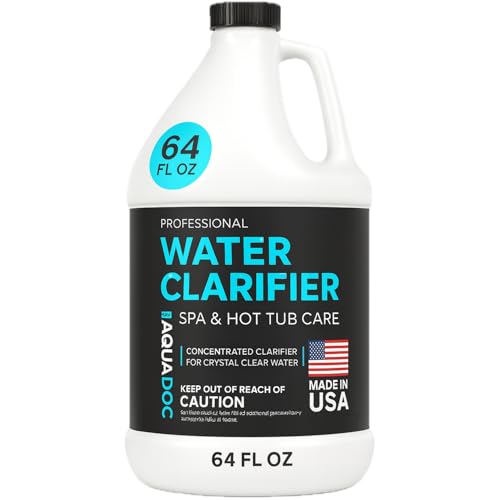
AquaDoc Hot Tub Clarifier is a concentrated liquid treatment designed to clear cloudy water and support routine cartridge filtration. It best suits hot tub owners, vacation rental hosts, and busy homeowners who experience dull or hazy water resulting from bather load, body lotions, or fine airborne debris. Instead of waiting for microscopic suspended solids to slowly cycle out through standard circulation, this formula acts as a coagulant to bundle tiny particles together so spa filters can trap them efficiently.
Microscopic dirt particles are frequently smaller than the micron rating of standard hot tub cartridge filters, allowing them to bypass filter pleats and keep the water looking hazy. AquaDoc works by attracting these micro-particles like a magnet, creating larger agglomerations that the filter media can physically catch. Running spa jets and blowers during application accelerates circulation, allowing the treatment to disperse evenly throughout the tub and push debris toward the skimmer intake.
Maintaining water balance is a central part of spa ownership, and chemical additions that swing pH can trigger scale or skin irritation. This clarifier is formulated to clear water without upsetting established pH levels, which helps avoid cascading chemical adjustments. By pulling floating debris out of suspension, it helps cartridge filters capture dirt effectively, though regular filter rinsing remains essential to flush away the collected material.
Applying the clarifier fits easily into weekly spa care routines without complicated steps. The manufacturer directions suggest adding 2 ounces for every 800 gallons of water while the jets or blowers are active, continuing filtration until the water turns clear. For standard residential tubs, which often hold between 300 and 450 gallons, measuring out roughly 1 ounce twice a week provides consistent water maintenance without over-treating.
While clarifiers improve mechanical filtration, they are not a substitute for proper sanitizer levels, oxidizers, or routine filter cleaning. If a hot tub filter cartridge is already loaded with oils or scale, adding a clarifier will yield limited results until the filter is thoroughly rinsed or degreased. Additionally, overdosing clarifier can have an inverted effect, where excess polymers temporarily cloud the water, making accurate measurement essential.
AquaDoc Hot Tub Clarifier is a reliable, practical addition to any spa chemical cabinet for clearing minor haziness and supporting regular filtration. Before adding it to your spa, verify your water sanitizer levels, test baseline pH, and inspect your cartridge filter to ensure it is clean and ready to trap the gathered particles. Hot tub owners looking for a low-fuss way to preserve water clarity between water changes will find good everyday value here.
Using AquaDoc Hot Tub Clarifier effectively requires basic attention to spa capacity and filtration cycles. The listed dosage is 2 ounces for every 800 gallons of water, meaning most typical residential hot tubs holding 350 to 400 gallons require approximately 1 ounce per application. Adding the measured dose twice weekly with the circulation jets running ensures thorough dispersion across the entire spa shell.
Because the clarifier works by grouping tiny particles into larger debris, your spa filter cartridge does the physical work of removing the cloudiness from the water. Running the filtration cycle until the water clears is essential, followed by a quick garden-hose rinse of the filter pleats to prevent the trapped coagulants from restricting water flow.
A Complete Guide to Hot Tub Water Capacity, Volume Calculations, and Maintenance Dynamics
Knowing the precise liquid volume inside your hot tub is the foundational starting point for every chemical addition, heating calculation, and structural installation. Most residential hot tubs hold between 200 and 500 gallons of water, with an average four-to-six person acrylic model containing approximately 350 to 400 gallons. Because spa manufacturers incorporate contoured seating, deep footwells, and integrated filter wells, calculating true volume requires looking past basic exterior cabinet dimensions. Understanding your actual gallon volume protects internal components from chemical corrosion, ensures sanitizer effectiveness, and prevents structural deck failure caused by uncalculated water mass.
Average Water Capacities Across Standard Hot Tub Sizes and Seating Layouts
Small two-person and three-person spas, including compact patio models and plug-and-play units, typically hold between 150 and 250 gallons of water. These smaller volumes heat rapidly and require very modest chemical doses to maintain sanitization balance. However, low gallon volumes react quickly to bather contamination, meaning a single soak can alter total alkalinity and pH faster than in larger tubs. Owners of these compact units must test their water frequently because chemical shifts occur rapidly in volumes under 250 gallons.
Mid-sized four-person to six-person spas represent the most common residential configuration and generally hold between 300 and 450 gallons. The presence of a dedicated ergonomic lounge seat significantly influences this total volume compared to an open barrier-free bucket layout. Molded loungers displace interior water space with fiberglass-backed acrylic, often reducing capacity by 30 to 50 gallons compared to bench-style models of identical exterior dimensions. This capacity provides balanced thermal stability without demanding excessive chemical adjustments after routine soaking sessions.
Large family spas designed for seven or more bathers generally hold between 500 and 650 gallons of water. Compact swim spas exceed these residential averages substantially, with capacities ranging from 1,200 to over 2,500 gallons. Managing high-volume vessels requires dedicated circulation systems, larger pleated cartridge filters, and substantially higher quantities of chemical oxidizers and biocides. While high-volume spas resist rapid temperature drops when the cover is removed, their immense liquid mass requires careful site engineering before delivery.
Mathematical Formulas to Calculate Hot Tub Gallons Accurately
Calculating the volume of a square or rectangular spa begins by multiplying internal length by width and average depth in feet to determine total cubic feet. One cubic foot of volume contains approximately 7.48 gallons of liquid. For example, a basic rectangular cavity measuring seven feet long, seven feet wide, and three feet deep yields 147 cubic feet, which equals roughly 1,099 theoretical gallons. This raw calculation assumes a completely hollow container, which does not reflect modern molded spa construction.
To account for internal seating structures, footwells, equipment steps, and armrests, you must adjust the hollow geometric calculation downward. Spa industry technicians typically apply a displacement reduction factor between 15 percent and 25 percent depending on shell complexity. Subtracting 20 percent from the earlier 1,099 theoretical gallon calculation yields approximately 879 gallons, bringing the figure closer to true water capacity. Always measure depth from the lowest point of the footwell to the recommended water fill line indicated on the skimmer faceplate.
Circular and round hot tubs require a different geometric formula based on the radius of the interior circle. To calculate round tub capacity, square the radius in feet, multiply by 3.14 to determine surface area, and then multiply by the average water depth in feet. Multiplying that resulting cubic volume by 7.48 provides the unadjusted gallon capacity of the circular shell. Applying a 10 to 15 percent displacement deduction for molded bench perimeters gives you a reliable baseline gallon figure for chemical dosing.
Empirical Measuring Methods: Flow Timers and In-Line Meters
If you want to determine volume without geometric formulas, you can measure actual fill volume using a standard garden hose and a timer. Start by placing your garden hose into a calibrated five-gallon bucket and recording the exact number of seconds required to fill it to the brim. Dividing five gallons by the measured seconds, then multiplying by 60, reveals your spigot flow rate in gallons per minute. Multiplying that flow rate by the total minutes required to fill your spa to the designated water line yields your precise gallon capacity.
A more precise empirical method involves threading an inexpensive in-line digital water flow meter directly between your outdoor hose spigot and the fill hose. These compact flow meters record the exact total volume of water passing through the hose in real time. As your spa fills, the meter display counts every gallon until the water reaches the skimmer halfway mark. Recording this exact number in your spa maintenance logbook eliminates guesswork when balancing water chemistry or calculating future drain and refill cycles.
When executing any fill or refill procedure, always place the garden hose directly down into the empty filter canister well rather than dropping it into the main footwell. Filling through the filter housing forces water directly into the internal plumbing manifolds, pump volutes, and heater tube from the bottom up. This bottom-up fill technique expels trapped air pockets that commonly cause pump air locks, heater low-flow error codes, and pressure switch tripping upon startup. Taking this precaution ensures that your newly measured water volume circulates smoothly the moment power is restored.
Chemical Balancing and Sanitizer Dosing Dictated by Gallon Capacity
Every water maintenance chemical you add to your spa relies strictly on the ratio between chemical weight and total water volume. Adding sanitizers, shock oxidizers, alkalinity increasers, or clarifiers without knowing your gallon capacity often causes chemical imbalances or hazardous water conditions. Overdosing granular chlorine or bromine can strip equipment seals, bleach acrylic shell finishes, and cause severe skin folliculitis or respiratory discomfort. Conversely, under-dosing sanitizers allows opportunistic bacteria, body oils, and organic biofilms to flourish rapidly in warm water environments.
Specialized maintenance chemicals illustrate why knowing your gallon capacity is critical for proper dosage calculations. For example, weekly clarifiers and multi-action maintenance formulas frequently require 1 fluid ounce per 100 gallons of water for an initial dose, transitioning to 0.5 ounces per 100 gallons for weekly upkeep. Highly concentrated hard water clarifiers and mineral scale removers often require just 2 fluid ounces to treat an entire 800-gallon volume for a week. Adding that same 2-ounce dose to a compact 200-gallon plug-and-play spa would represent a fourfold overdose, causing foamy residue and filter clogging.
Using comprehensive starter bundles simplifies chemical management only when you align the included dosage charts with your verified water volume. Routine balancing targets require maintaining free chlorine between 3.0 and 5.0 parts per million, total alkalinity between 80 and 120 parts per million, and pH between 7.2 and 7.8. When adjusting total alkalinity, adding sodium bicarbonate in exact ounce measurements per 100 gallons prevents dramatic pH bounce. Knowing your exact volume allows you to make measured chemical corrections without constantly chasing fluctuating test strip readings.
Structural Foundation Engineering and Filled Water Weight Loads
Understanding water volume is an absolute engineering requirement when evaluating whether a patio, deck, or structural foundation can safely support a hot tub. Ambient water weighs approximately 8.34 pounds per single US gallon, creating tremendous downward force across a concentrated footprint. A typical mid-sized spa holding 375 gallons contains roughly 3,128 pounds of liquid weight alone. Adding the dry weight of the acrylic shell and cabinet, plus the average weight of four adult bathers, easily pushes the total operating load past 4,500 pounds.
Structural engineers calculate deck load capacity using a pounds-per-square-foot formula that directly incorporates filled water volume. The total load formula equals dry spa weight plus water volume multiplied by 8.34 pounds, plus occupant capacity multiplied by 175 pounds, divided by the footprint square footage. While standard residential backyard decks are engineered to support 40 to 50 pounds per square foot, a filled spa regularly generates loads between 100 and 150 pounds per square foot. Installing a hot tub on an existing elevated wooden deck without reinforcing the joists, ledger boards, and support posts risks severe structural collapse.
Ground-level installations require an unyielding, perfectly level foundation pad to prevent structural shell flexing and acrylic cracking under heavy water mass. A minimum four-inch reinforced poured concrete pad with rebar or welded wire mesh provides the standard for long-term load distribution. Protecting that investment requires pairing your foundation with a heavy-duty thermal spa cover to shield the cabinet, prevent rainwater accumulation, and stop unwanted surface moisture from degrading structural framing. Proper site planning ensures your foundation handles every gallon of water safely over decades of seasonal use.
Thermal Dynamics, Heating Times, and Power Consumption by Water Volume
The volume of water in your spa directly dictates how many kilowatt-hours of electrical energy are needed to raise and maintain soaking temperatures. Water possesses a very high specific heat capacity, requiring 8.33 British Thermal Units (BTUs) to raise one gallon of water by one degree Fahrenheit. Heating a 400-gallon hot tub from a 50-degree fill temperature up to 104 degrees Fahrenheit requires roughly 180,000 BTUs of thermal energy. A standard 4-kilowatt electric heater operating on a 230-volt line produces approximately 13,650 BTUs per hour, requiring roughly 13 to 14 hours of continuous heating.
This thermal math highlights the operational performance differences between 110-volt plug-and-play spas and dedicated 230-volt hardwired installations. A 110-volt plug-and-play unit typically features a small 1.0-kilowatt to 1.5-kilowatt heater that raises water temperature by only one to two degrees per hour. Furthermore, standard 110-volt control packs cannot run the electric heater simultaneously while the jet pump operates on high speed. For larger volumes exceeding 300 gallons, cold ambient air quickly saps heat during winter soaks unless the system is backed by a 230-volt, 50-amp circuit capable of concurrent heating.
Once your water volume reaches the target soaking temperature, standby heat loss becomes your primary ongoing electrical expense. Dense closed-cell full-foam cabinet insulation and a high-efficiency insulated hot tub cover with a continuous heat-seal hinge prevent thermal escape into freezing air. Standardized energy test protocols like California Energy Commission Title 20 demonstrate that poorly insulated large-volume spas suffer massive standby power consumption compared to tight thermal setups. Maintaining a tight vapor barrier over your water volume keeps monthly electrical utility costs manageable regardless of outside temperatures.
Water Replacement Schedules: Calculating Drain and Refill Frequencies
Every gallon of water in your hot tub gradually accumulates dissolved minerals, dead skin cells, cosmetic residues, and chemical byproducts that filtration cannot remove. Over time, this buildup increases Total Dissolved Solids (TDS) levels, causing water to look dull, foam excessively, and resist chemical balancing. The Association of Pool and Spa Professionals provides a standardized mathematical formula to determine when your volume needs a complete drain and refill. Dividing your total hot tub gallons by three, and then dividing that number by your average daily bather count, yields the recommended number of days between water replacements.
Applying this drain formula demonstrates the practical impact of water capacity on routine maintenance schedules. In a 300-gallon spa used by two bathers every day, dividing 300 by three equals 100, and dividing 100 by two bathers recommends a complete drain every 50 days. In contrast, a 450-gallon spa with that same two-bather usage yields 75 days between recommended water changes. Adhering to this volume-based replacement schedule prevents saturation buildup that causes scale accumulation on internal titanium heater elements and pump mechanical seals.
Executing a routine drain and refill begins by disconnecting power at your dedicated GFCI breaker panel to prevent accidental pump dry firing. You can discharge water through the built-in cabinet drain spigot or accelerate the process using a submersible utility pump attached to a discharge hose. Once empty, wipe down the acrylic shell with a non-abrasive spa cleaner, inspect your jet nozzles, and rinse your pleated filter cartridges thoroughly. Refilling the exact measured volume through the filter standpipe resets your water chemistry slate, ensuring clean, crystal-clear soaking for months to come.








Write Your Review
No reviews yet. Be the first to share your experience!