


Cold winter evenings often expose the frustrating reality of slow water heating and sudden temperature drops when soaking outdoors. Selecting between dedicated electrical upgrades and standard outlet convenience defines your entire spa experience, which makes understanding a 110 volt vs 220 volt hot tub essential before buying equipment. While standard household circuits offer quick plug-and-play convenience, higher voltage configurations supply continuous power to run powerful massage jets and heating elements simultaneously. Adding a heavy-duty yard patio hot tub cover helps trap existing warmth regardless of your power supply, but the underlying electrical delivery dictates how fast your water recovers after the cover comes off.
Careful analysis of product specifications and user feedback reveals significant differences in operational flow rates and heater wattage. Dedicated 240V setups easily support high-output 4.0 kW heaters and brawny 4 HP circulation pumps, maintaining heat even in freezing climates. In contrast, compact 110V components rely on 1.0 kW to 2.0 kW elements that take longer to reach soaking temperature but avoid costly sub-panel installations. Evaluating your outdoor electrical infrastructure alongside pump frame sizes and heater manifold dimensions ensures you match your hydrotherapy expectations with your home power capacity.


Frequently Asked Questions
Does a 220V hot tub heat faster than a 110V model?
Yes, a 220V hot tub heats significantly faster than a standard 110V model. A 240V connection supports larger 4.0 kW heating elements like the Balboa M7 assembly, raising water temperatures by about three to six degrees per hour. Standard 110V systems typically use 1.0 kW to 2.0 kW heaters, often heating at just one to two degrees per hour. Cold-climate installations especially benefit from higher voltage because the heater can run continuously even while high-speed therapy jets are active.
Can you run the heater and hydrotherapy jets at the same time on a 110V circuit?
No, most 110V plug-and-play hot tubs cannot run the heater and high-speed jet pump at the same time. Standard 15A or 20A household circuits lack the electrical capacity to power both high-draw components simultaneously. The control system automatically shuts off the heating element whenever you switch the pump to high-speed massage mode. Protecting heat retention with a durable hot tub cover with warranty prevents rapid water cool-down while the tub operates in jet mode.
Is professional electrical installation required for a 110 volt vs 220 volt hot tub upgrade?
Yes, converting to a 220V configuration requires dedicated wiring and an outdoor sub-panel installation. Setting up a 220V or 240V system involves running four-wire conduit with a dedicated 50A or 60A GFCI breaker from your main panel to an outdoor shut-off box. In contrast, 110V setups plug directly into an existing outdoor 15A or 20A GFCI receptacle without requiring major electrical changes. Homeowners must weigh these upfront installation expenses against the performance benefits of multi-horsepower pumps.
What size pump is suitable for 220V versus 110V spa configurations?
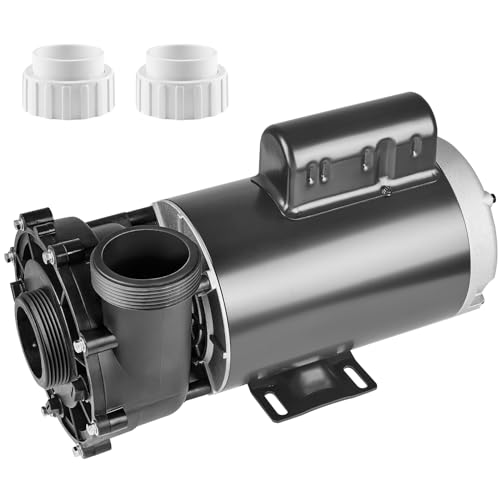
High-output 56-frame pumps running up to 4 HP require a dedicated 220V circuit to operate efficiently. Dual-speed pumps like the VEVOR 56-frame unit move up to 210 gallons per minute on high speed to power extensive jet arrays. Smaller 110V hot tubs usually pair with modest pumps rated under 1.5 HP or low-wattage circulation pumps to prevent tripping household breakers. Matching pump flow rates with proper manifold sizing ensures balanced water pressure and prevents motor overheating.
How does operating voltage affect monthly electricity bills?
Monthly operating costs depend largely on heat retention and ambient temperatures rather than voltage alone. A 220V heater draws more watts initially but runs for a much shorter duration to reach temperature compared to a 110V heater. Maintaining insulation quality and using a tight-sealing silent hot tub cover helps lower heat loss during freezing periods. Overall, energy consumption in kilowatt-hours remains relatively similar across both setups when maintaining identical water volumes.






Write Your Review
No reviews yet. Be the first to share your experience!