

Manual vacuuming and brushing can turn routine pool care into a recurring chore, especially after leaves, pollen, or windblown debris settle on the floor. The answer to what is the best dolphin robotic pool cleaner depends on your pool type, the areas you need cleaned, and whether a corded or cordless setup suits your routine. Product descriptions list options for above-ground pools, inground pools, and pools of different sizes, so checking the intended use matters more than choosing by name alone.
Coverage is a key distinction. Some listed Dolphin models are described as cleaning floors and walls, while the Nautilus AG is specifically described as not cleaning walls or the waterline. Filter access, cycle time, pool length rating, and the effort involved in removing debris also affect everyday convenience. The Letexpool C1 adds a cordless design and app controls, but its listed features and pool-size guidance differ from the corded Dolphin options.
This guide explains how those differences translate into a sensible shortlist, without treating advertised features as proof that a cleaner will handle every drain, step, or surface equally well. Confirm the manufacturer’s current compatibility guidance for your pool finish and shape before buying. The supplied product information does not establish micron ratings, cable lengths, or detailed surface compatibility for every model, so those specifications should be verified rather than assumed.
Top Products



What the Dolphin Options Offer
A robotic cleaner can reduce the amount of manual floor cleaning, but no one model is automatically best for every pool. In this selection, the practical choice starts with whether the pool is above ground or inground, how much of the pool needs active cleaning, and whether a cord or battery-powered unit fits the owner’s preferences. The product descriptions provide some useful distinctions, but they do not give a complete specification sheet for every decision a buyer might need to make.
For example, a cleaner described for an above-ground pool may not be the right choice for an inground pool with different dimensions or a more complex profile. Conversely, a model listed for an inground pool may offer features that a smaller above-ground setup does not need. Pool dimensions, steps, ladders, slopes, and drains can influence how reliably a cleaner moves through the space, but the supplied listings do not document performance on every obstacle or shape.
Match pool type and coverage before comparing extras
The Dolphin Nautilus AG is listed for above-ground pools up to 33 feet long. Its features include an active scrubber brush, top-load filter access, smart navigation, and a stated cleaning time of 1.5 hours. The listing also specifically says it does not clean walls or the waterline, so it is best considered by shoppers whose priority is floor cleaning rather than full-wall coverage.
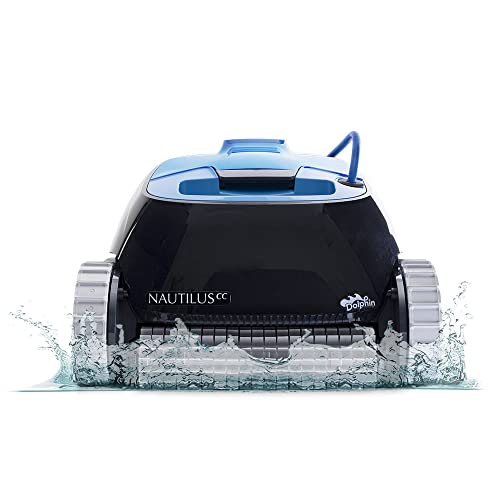
The Nautilus Pool-Up is listed for pools up to 26 feet and described as suitable for small pools, with wall climbing and a scrubber brush. The Nautilus CC is listed for above-ground and inground pools up to 33 feet, with wall climbing, active scrubbing, and top-load filter access. These descriptions suggest different pool-size and coverage priorities, but they do not establish that either model handles every step, tanning ledge, or raised main drain without interruption.
For a larger listed pool, the Nautilus CC Plus is described for inground pools up to 40 feet and includes wall climbing, active scrubbing, and smart navigation. The Proteus DX3 is listed for inground pools up to 33 feet, with wall climbing, a top-load filter basket, active scrubbing, and a stated two-hour cycle. Check the pool’s actual length and layout against the product’s manufacturer guidance, and do not assume a length rating alone guarantees complete coverage of unusual corners or built-in features.
Understand the difference between floor, wall, and waterline cleaning
“Wall climbing” and “waterline cleaning” are not interchangeable promises. The Nautilus AG description explicitly excludes wall and waterline cleaning, while the Proteus DX3 and several Nautilus listings describe wall climbing. The Letexpool C1 description specifically includes floor, wall, and waterline cleaning among its functions, but its advertised modes and paths should be reviewed against the manufacturer’s instructions and the pool’s profile.
Waterline residue can be stubborn, and a cleaner’s ability to reach a wall does not necessarily mean it will scrub every waterline area in every pool. Tile bands, steep transitions, steps, and smooth finishes may change how the unit moves. The supplied details do not identify brush materials or confirm surface-specific traction for all products, so confirm finish compatibility before relying on a general wall-climbing description.
Owners dealing with a persistent algae ring or scale line should also distinguish routine debris cleaning from water chemistry or surface-cleaning needs. A robotic vacuum is not a substitute for maintaining balanced pool water or addressing a buildup that requires a separate cleaning method. Follow the pool and cleaner manufacturers’ instructions for the pool’s finish, and avoid using an automated cleaner as the sole remedy for a persistent waterline problem.
Choose filtration and debris access for your cleanup routine
Top-load access is a recurring feature in the Dolphin descriptions. The Nautilus AG, Proteus DX3, Nautilus CC, and Nautilus CC Plus list filter access from the top, which can make it easier to reach the collection basket than a design that requires turning the unit over. The Escape is described with a large top-loading debris cartridge, while the C1 listing refers to a dual-layer filtration system.
Those descriptions do not specify micron ratings or guarantee capture of very fine silt, pollen, or dead algae. A top-load basket describes access, not filtration fineness. If your main concern is fine suspended debris, verify the filter type and particle-capture specification with the seller or manufacturer before purchase, and check whether the appropriate replacement filters are available.
Debris type also affects how often a basket needs attention. Leaves and larger organic material can fill a filter more quickly than light routine debris, while fine material can call for a different filter media than a standard basket. None of the supplied listings provides a specific capacity for most baskets, so avoid relying on an assumed emptying interval. Inspect and rinse the filter according to the product instructions, with the unit disconnected from its power source before maintenance.
Compare corded convenience with the cordless C1
Most of the listed Dolphin cleaners use a plug-and-play setup: connect the supplied system as instructed, place the robot in the pool, and start its cycle. The product descriptions state cycle times of 1.5 hours for the Nautilus AG and two hours for the Proteus DX3, Nautilus Pool-Up, Nautilus CC, and Nautilus CC Plus. These are listing claims, not a guarantee that every pool’s debris load or shape will be cleaned completely within that time.
The Letexpool C1 is described as cordless, with app control, seven cleaning modes, a 180-minute runtime, and a two-and-a-half-hour full charge. Its listing says it is intended for inground pools up to 1,615 square feet. Those figures are manufacturer-provided specifications and should be checked against current product documentation, especially if the pool is large or has a complicated layout. The listing also says to set the mode before placing the unit in water.
A cordless robot avoids arranging a floating power cable during cleaning, but battery operation introduces charging and retrieval considerations. The supplied C1 information does not describe a retrieval hook or an automatic return-to-wall feature, so do not assume it will be easy to retrieve if its battery runs down in deep water. Follow the included instructions for safe removal, and use a suitable method that does not require entering deep water or pulling on an electrical component.
Corded models avoid a battery recharge interval, but their cable still needs orderly placement and storage. Do not pull a powered robot from the pool by its cable. Follow the manufacturer’s guidance for power-supply placement, electrical protection, cable handling, and removal. Verify GFCI protection and keep electrical equipment positioned as instructed for the specific product and pool installation.
What the Escape and caddy add to the shortlist
The Dolphin Escape is described for above-ground and inground pools up to 33 feet, with a large top-loading cartridge, dual motors, HyperBrush, HyperGrip tracks, and SmartNav 2.0 navigation. Its listing gives a weight of 14 pounds and describes quick water release. These are useful points for buyers comparing debris access, traction design, navigation, and handling, but they do not establish that the Escape will be easier to lift for every person or pool setup.
Its stated pool compatibility includes vinyl, fiberglass, and gunite surfaces. That makes the product description more specific about surface types than some other listings in this group. Still, a listed surface range is not a substitute for checking the current manufacturer instructions for your exact finish, especially where a pool has delicate areas, repairs, or unusual transitions.
The Dolphin Universal Caddy is an accessory, not a pool-cleaning robot. Its listed purpose is to help transport and store a compatible residential Dolphin cleaner and organize the cable and power supply. Buyers who already own a compatible robot may value the storage arrangement, but the caddy should not be mistaken for a feature that improves cleaning coverage or filtration.
Storage matters because a robot, cable, filter, and power supply all need appropriate care between cycles. Follow the product instructions for rinsing, drying, and storing components, and avoid leaving equipment exposed to conditions the manufacturer warns against. If you are considering a caddy, confirm the accessory’s compatibility with your exact cleaner and leave adequate room for the power unit and cable.
Make a shortlist based on the pool you actually have
For an above-ground pool up to 33 feet where floor cleaning is the main goal, the Nautilus AG has a clearly stated pool type and a clear wall-cleaning limitation. For a smaller pool where wall climbing is a priority, the Pool-Up is listed for up to 26 feet. For an inground pool up to 33 feet, the Proteus DX3 describes wall climbing and top-load filtration, while the Escape offers a different package with listed tracks, navigation, and more explicit surface guidance.
For an inground pool that approaches 40 feet, the Nautilus CC Plus has the largest pool-length rating among the listed Dolphin robots. The Nautilus CC is listed for pools up to 33 feet and includes wall climbing, while the C1 offers cordless operation and app controls with its own pool-area rating. These are starting points for comparison, not a ranking, because the best match depends on pool geometry, cleaning priorities, and the manufacturer’s full compatibility details.
Before ordering, verify the exact model name, included filter, power arrangement, pool-size limit, and surface guidance. Ask whether replacement filters, brushes, and other service parts are available for the model you plan to keep. If a high-profile drain, steps, or a tanning ledge causes recurring trouble with your current cleaner, seek specific guidance about that obstacle rather than assuming a different robot will pass it without issue.
Keep cleaning expectations realistic after purchase
A robotic cleaner can take on a defined part of pool maintenance, but it does not replace skimming, water testing, brushing areas it misses, or maintaining circulation and filtration. A robot that collects debris internally may still need frequent filter attention during heavy leaf fall or after a dusty day. A full basket can also affect how well the cleaner performs, so follow the manufacturer’s cleaning and maintenance schedule rather than waiting for a visible problem.
Pool chemistry and safe operating conditions matter to equipment care. Remove or operate the cleaner around chemical treatments only as directed by its manufacturer, and do not assume a robot can remain in the water during a shock treatment. Product descriptions supplied here do not state specific chemical limits or water-temperature cutoffs, so consult the manual for those thresholds instead of relying on generic advice.
Electrical safety also deserves attention with corded equipment. Use the power supply, outlet, and GFCI protection specified by the manufacturer and local requirements. Disconnect power before cleaning or servicing the robot, and never modify a cable or bypass a protective device. These precautions are part of choosing a workable setup, not an optional extra.
So, the most suitable choice is the model whose pool-size rating, coverage, and operating style match your installation. The Nautilus AG is a floor-focused above-ground option, several Nautilus and Proteus listings add wall climbing, and the C1 stands out in this selection for its cordless operation and stated app controls. Confirm details that matter to your pool directly with the manufacturer, particularly fine-filtration capability, surface compatibility, obstacle handling, and replacement-part support.




Write Your Review
No reviews yet. Be the first to share your experience!