
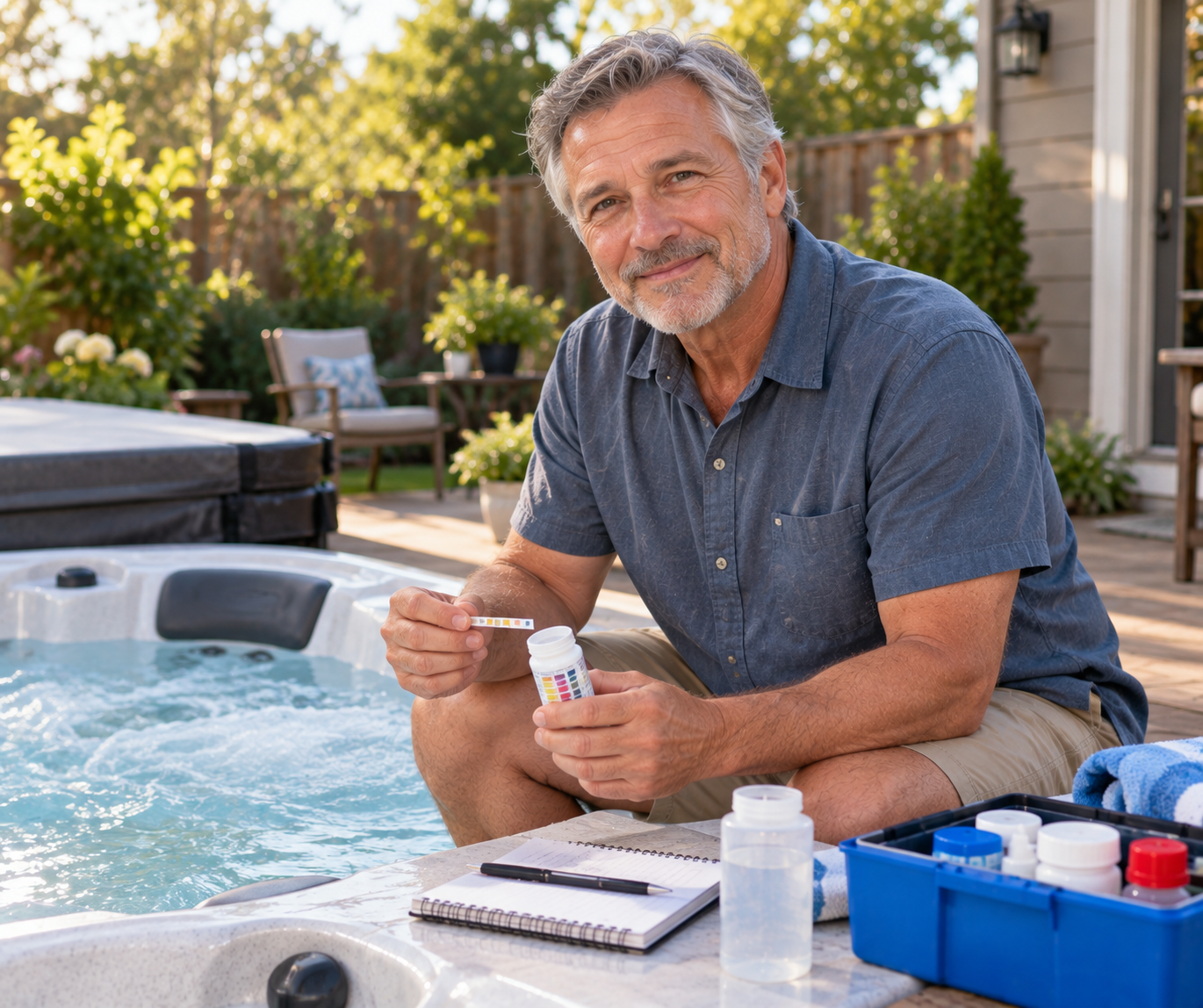

Stepping up to your spa expecting a relaxing soak only to be hit by an overwhelming bleach scent is an all too common frustration. High chemical levels irritate sensitive skin, cause burning eyes, and can slowly deteriorate expensive internal gaskets and plumbing seals. Learning how to reduce total chlorine in hot tub water is essential for restoring a safe, comfortable, and chemically balanced soaking environment. Managing this parameter quickly prevents unnecessary equipment wear and keeps your spa ready for daily hydrotherapy sessions.
Total chlorine readings reflect both active sanitizing power and used chemical compounds bound to organic matter. When levels remain excessively high, trapping that chemical vapor beneath your hot tub lid can degrade acrylic surfaces, headrests, and an insulated spa cover with warranty protection. Fortunately, lowering total chlorine is straightforward once you identify whether you are dealing with fresh sanitizer overdosing or spent chloramines. With the right testing methods and targeted adjustments, you can bring your water back into the ideal range without draining your tub completely.


Pros
- EPA-registered product that is listed as compatible with a wide range of sanitizer systems including bromine, chlorine, ozone, and mineral sticks
- Targets internal plumbing and jet bio-contamination that surface-level cleaning products typically miss
- Simple one-ounce-per-100-gallons weekly dosing keeps the maintenance routine uncomplicated
- Compact and lightweight at just 2 oz and 0.125 lbs, making it easy to store and handle
- May reduce overall sanitizer consumption and extend the useful life of other water-care chemicals
Cons
- The 2 oz bottle is quite small, so owners with larger hot tubs (400+ gallons) will use through the product quickly and may need to reorder frequently
- Not a standalone sanitizer or oxidizer, so buyers still need a primary sanitizer system for safe water care
- Results may vary depending on existing plumbing contamination levels, water chemistry balance, and how consistently the weekly dosing schedule is followed
Hot Tub Serum Total Cleanse Gel is a concentrated weekly maintenance treatment designed to address organic contamination inside hot tub plumbing, jets, and water. It's not a sanitizer or oxidizer - it's an EPA-registered supplemental product that works alongside your existing water-care system. This makes it best suited for hot tub owners who already maintain a sanitizer regimen (bromine, chlorine, ozone, or mineral-based) but want a deeper clean for the internal components that standard chemicals don't always reach effectively.
The core value proposition of Hot Tub Serum Total Cleanse Gel centers on plumbing and jet-line cleanliness. Biofilm and organic buildup inside pipes and jet assemblies are common issues that many hot tub owners don't realize they have until water clarity degrades or sanitizer demand spikes unexpectedly. The product description indicates this gel targets that internal contamination while also working to improve overall water clarity and soften water for better debris separation. For owners who've noticed their sanitizer seems to deplete faster than expected, or who see cloudy water despite balanced chemistry, a product like this may address the underlying cause rather than just the symptoms.
Dosing is straightforward: one ounce per 100 gallons of water, applied weekly. Given that the bottle contains just 2 oz, owners should be aware that this is a relatively small supply. A standard 300-gallon hot tub would use 3 ounces per week, meaning this single bottle wouldn't last through even one full weekly treatment for many common spa sizes. Buyers should factor in ongoing reorder costs and may want to purchase multiple bottles or look for larger quantity options if available. The compact size (listed at 2 x 2 x 2 inches and 0.125 lbs) does make it extremely easy to tuck into a spa-side caddy or chemical storage bin.
One of the more practical benefits listed is the product's potential to increase filtration efficiency. By reducing the organic load circulating through the water, the filter cartridge may not clog as quickly, which can translate to better water flow and potentially longer intervals between deep filter cleanings. This doesn't replace regular filter maintenance - owners should still rinse and inspect their filter cartridges on a normal schedule - but it may ease the burden. The product description also notes that it's designed to protect heater elements and pipe jets, which could help owners avoid premature component failures that lead to expensive repairs.
There are some realistic limitations to consider. This product is explicitly not a sanitizer or oxidizer, so it cannot replace your primary water-care system. Owners still need to maintain proper sanitizer levels, pH balance, and alkalinity independently. Additionally, the effectiveness of any plumbing-cleaning product depends heavily on the starting condition of the spa's internal lines. A hot tub with years of neglected biofilm buildup may need a dedicated purge or flush product before transitioning to a weekly maintenance treatment like this one. First-time users should also verify that their specific water-care setup is compatible, even though the product lists broad compatibility with bromine, chlorine, ozone, enzymes, and mineral sticks.
Hot Tub Serum Total Cleanse Gel may be a good fit for maintenance-focused hot tub owners, vacation-rental operators, and property managers who want to keep internal plumbing clean between water changes without adding complexity to their existing chemical routine. Budget-conscious buyers should note the small bottle size relative to typical spa volumes and plan their purchasing accordingly. Before buying, verify your hot tub's water capacity so you can accurately gauge how many treatments the 2 oz bottle will provide for your specific setup.
Hot Tub Serum Total Cleanse Gel is designed as a weekly-use product with a simple dosing protocol: one ounce per 100 gallons of spa water. This makes it easy to incorporate into an existing maintenance schedule without requiring special tools, mixing, or complicated procedures. Simply measure the appropriate amount based on your spa's water volume and add it directly to the water.
The product is listed as compatible with bromine, chlorine, ozone, enzymes, mineral sticks, and other common hot tub chemicals. However, owners should always verify compatibility with any specialized or proprietary water-care systems they may be using. It's also worth noting that this product addresses internal plumbing and jet contamination, which complements but does not replace surface cleaning, filter cartridge maintenance, or regular water testing and balancing.
For spas that haven't been treated with a plumbing-cleaning product before, some owners may notice initial changes in water clarity or debris as buildup begins to break down. This is a normal part of the cleaning process. Maintaining consistent weekly dosing, as the manufacturer recommends, is likely important for sustained results. Owners who drain and refill their hot tub seasonally should consider whether to continue treatment through the refill cycle for ongoing plumbing protection.
Complete Guide to Lowering Total Chlorine and Restoring Spa Water Balance
Lowering total chlorine in a hot tub begins with understanding what your water test reading actually represents. Total chlorine is not a single chemical entity, but rather the sum of free chlorine and combined chlorine. If your total chlorine reading is off the charts, applying the wrong corrective measure can either waste money or leave your water vulnerable to dangerous bacteria. By determining whether your issue stems from an accidental chemical overdose or an accumulation of spent chloramines, you can execute the exact corrective procedure needed.
Understanding Total Chlorine: Free Chlorine Versus Chloramines
Chemical test strips and liquid test kits report sanitizer presence in distinct measurements. Free chlorine refers to the hypochlorous acid and hypochlorite ions available in the water to actively disinfect pathogens and oxidize bather waste. Combined chlorine, commonly known as chloramines, forms when free chlorine binds to ammonia, sweat, cosmetics, body oils, and organic nitrogen compounds. Total chlorine is simply the mathematical sum of these two measurements, expressed by the equation where total chlorine equals free chlorine plus combined chlorine.
Many spa owners mistakenly assume that a strong, pungent chlorine odor indicates that the water has too much active sanitizing chlorine. In reality, that unmistakable locker room smell is almost always caused by high combined chlorine rather than free chlorine. Pure free chlorine at proper soaking levels of 1.0 to 3.0 parts per million has very little noticeable scent. When chloramines build up above 0.5 parts per million, they irritate mucous membranes, cause itchy skin, and indicate that your active sanitizer is overwhelmed by bather contamination.
Conversely, you may encounter situations where total chlorine is elevated because free chlorine was accidentally overdosed. Dumping too many chlorinating granules into a small 350-gallon spa after a gathering can easily spike free chlorine above 10 parts per million. When free chlorine is that high, total chlorine naturally reads equally high, even if combined chlorine is zero. Differentiating between these two scenarios dictates whether your goal is to eliminate spent chloramines or simply bleed off excessive active biocide.
Testing Spa Water to Diagnose the Chemistry Imbalance
Accurate diagnosis requires reliable water testing before adding any corrective chemicals to your spa. Basic two-way test kits often measure only total chlorine, leaving you completely in the dark regarding the free versus combined ratio. High-quality test strips or liquid DPD test kits provide separate pads for free chlorine and total chlorine, allowing you to calculate combined chlorine instantly. If your total chlorine is 5.0 parts per million and your free chlorine is 1.0 parts per million, you have 4.0 parts per million of combined chloramines demanding immediate attention.
All-in-one maintenance packages like the Hot Tub Things Chlorine Starter Kit for Hot Tub provide comprehensive test strips alongside essential balancing chemicals. Evaluating pH and total alkalinity during this diagnostic phase is equally critical because sanitizers perform erratically in unbalanced water. If your pH drifts above 7.8, the oxidizing efficacy of chlorine drops significantly, causing rapid chloramine formation. Maintaining your total alkalinity between 80 and 120 parts per million buffers the water against sudden pH swings while you work to correct sanitizer levels.
Testing should always be performed with the spa circulation pump running for at least five minutes to ensure uniform mixing. Dip the test strip at least twelve inches beneath the surface, away from the skimmer intake and jet returns. Compare the pads against the color chart within the exact timeframe specified on the bottle, usually between fifteen and thirty seconds. Recording your readings in a notebook helps track whether your corrective actions are moving the chemistry in the right direction.
Method 1: Natural Dissipation Through Aeration and Sunlight
If your diagnostic test shows that total chlorine is high solely because free chlorine is elevated, natural dissipation is often the easiest remedy. Ultraviolet rays from direct sunlight naturally break down free chlorine molecules at a rapid pace. Removing your protective patio hot tub cover during a bright, sunny afternoon can reduce free chlorine levels by several parts per million in just a few hours. This approach requires zero added chemicals, making it ideal for mild overdoses between 5.0 and 8.0 parts per million.
Aeration dramatically accelerates the dissipation process by encouraging chemical off-gassing into the atmosphere. Turn on your hydrotherapy jet pumps and open all topside air control valves to maximize bubbling and surface agitation. The violent mixing action helps release volatile compounds from the heated water into the surrounding open air. Run the jets for thirty-minute intervals, checking the water temperature periodically so the heater does not overwork while the lid is off.
Never leave your hot tub uncovered and unattended if small children or pets have access to the backyard. In addition, prolonged exposure to open air can cause ambient heat loss, particularly during chilly autumn or winter months. Balance the duration of cover removal with your climate conditions to avoid running up excessive heating electricity costs. Once chlorine drops to the safe soaking range of 1.0 to 3.0 parts per million, reinstall the lid immediately to conserve thermal energy.
Method 2: Using Non-Chlorine Shock to Destroy Combined Chlorine
When high total chlorine is driven by elevated combined chlorine rather than free chlorine, aeration and sunlight will not solve the problem. Chloramines are chemically stable compounds that resist simple off-gassing and require aggressive chemical oxidation to break apart. Adding standard chlorine shock might seem logical, but it adds even more chlorine into water that is already struggling with chemical balance. Non-chlorine shock oxidizers formulated with potassium peroxymonosulfate provide the exact oxidizing power needed without introducing any additional chlorine residual.
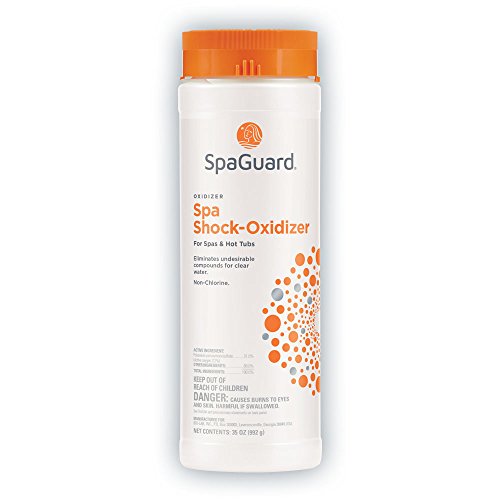
Treatments such as In The Swim Spa & Hot Tub Care Chlorine-Free work by directly attacking and destroying organic contaminants. Similarly, SpaGuard Spa Shock Oxidizer for Spas & Hot Tubs breaks the chemical bonds of chloramines, converting bound nitrogen into harmless gas that vents away. Because these products contain zero chlorine, they oxidize the contaminants that consume your sanitizer while allowing the total chlorine reading to drop back in line with free chlorine. They dissolve rapidly in hot water and allow bathers to resume soaking within fifteen minutes after application.
To apply non-chlorine shock effectively, remove the spa cover and ensure the primary circulation pump is running on high speed. Broadcast the recommended dose evenly across the water surface, typically around two ounces per five hundred gallons of water capacity. Leave the cover completely open for at least twenty minutes so that oxidized gases can escape freely without reacting against the underside of your lid. Retest your free and total chlorine levels several hours later to verify that the chloramine gap has closed.
Method 3: Dilution and Partial Water Replacement
When chlorine levels are dangerously high, exceeding 10.0 or 15.0 parts per million, waiting for natural dissipation can take several days. Extreme sanitizer levels can bleach acrylic shells, degrade headrests, and cause permanent damage to your pump wet ends and heater elements. Under these circumstances, performing a partial drain and refill is the fastest and safest way to lower total chlorine. Draining one-third to one-half of your spa water and refilling with fresh tap water immediately cuts the sanitizer concentration by that exact proportion.
Before draining any water, always turn off the dedicated breaker at your emergency GFCI disconnect switch. Running pumps or heaters without adequate water levels will trigger dry-fire error codes and can destroy delicate heating elements within seconds. Use a submersible utility pump or open the low-point gravity drain valve to discharge the calculated volume of water. When refilling, insert the garden hose directly down into the filter housing canister to force trapped air out of the plumbing manifolds and prevent pump air locks.
Replacing old water also resolves underlying water quality issues like high total dissolved solids and elevated cyanuric acid. If you have used dichlor granules for several months, cyanuric acid may have accumulated past 100 parts per million, creating chlorine lock. In a chlorine-locked tub, free chlorine reads high on test strips but is chemically immobilized and unable to sanitize effectively. Fresh water dilution strips away excess stabilizer, lowering total chlorine while restoring the active disinfecting power of your remaining chemical residual.
Method 4: Chemical Neutralizers for Rapid Chlorine Reduction
If you must use your hot tub immediately and have severely overdosed the sanitizer, chemical neutralizers offer an instant fix. Products based on sodium thiosulfate chemically react with chlorine molecules on contact, neutralizing them into harmless salts. This process takes effect in a matter of minutes, dropping sky-high chlorine levels down to safe soaking parameters. However, chemical neutralizers require extreme precision because adding even a fraction of an ounce too much can wipe out all sanitizer completely.
Always dose chlorine neutralizer incrementally, using no more than half of the manufacturer-recommended quantity on your initial attempt. Dissolve the measured crystals in a clean plastic bucket of warm spa water before pouring the slurry around the perimeter of the tub. Let the circulation pump run on high speed for at least twenty minutes to disperse the neutralizer thoroughly through all jets. Test the water again before adding any additional neutralizer to ensure you do not drive your free chlorine level down to zero.
Driving chlorine to absolute zero leaves your warm water completely unprotected against rapid bacterial growth and pseudomonas colonization. If an accidental overdose of neutralizer wipes out your sanitizer residual, you will have to re-chlorinate the tub from scratch. Furthermore, excess sodium thiosulfate remaining in the water will actively neutralize any new chlorine granules you add for days afterward. For this reason, reserve chemical neutralizers as a last resort when natural dissipation or dilution are not feasible options.
Purging Plumbing Lines to Prevent Chronic Chloramine Accumulation
Some hot tubs suffer from recurring high total chlorine and stubborn chloramines despite constant shocking and chemical balancing. In many instances, the root problem is not in the open water volume but hidden deep within hundreds of feet of internal flex plumbing. Biofilm, body oils, and organic sludge coat the inside of PVC pipes, constantly reacting with fresh sanitizer and converting it into spent chloramines. Until this organic plumbing biofilm is thoroughly purged, your chlorine will continuously decay into foul-smelling combined compounds.
Utilizing a specialized treatment like Hot Tub Serum Total Cleanse Gel attacks organic plumbing contamination and jet-bio accumulation directly. This EPA-registered serum works alongside chlorine, bromine, or ozone systems to deep-clean pipe walls and prevent persistent sanitizer decay. By clearing the internal biofilm that feeds chloramine creation, the treatment allows your free chlorine to remain active much longer with smaller chemical additions. It also improves filtration efficiency by coagulating microscopic debris so that pleated paper filter cartridges can capture it easily.
Apply weekly maintenance doses of plumbing cleanser directly into the filter well with the jets running on low circulation speed. Whenever you perform a quarterly drain and refill, consider running a concentrated line flush through the system before evacuating the water. Rinsing away dislodged biofilm before refilling ensures that fresh water does not immediately inherit a massive organic contaminant load. Keeping your plumbing lines clean minimizes the chemical volume required to maintain crystal-clear water throughout the year.
Common Mistakes That Spike Total Chlorine Levels
Many chemical spikes occur simply because spa owners treat a 400-gallon hot tub like a 20,000-gallon backyard swimming pool. In a small volume of heated water, adding just one extra tablespoon of chlorinating granules can send sanitizer levels soaring out of control. Always read chemical dosing labels carefully and calculate your additions based on the exact water capacity specified in your owner manual. Measuring scoops should be dedicated exclusively to spa chemicals to prevent cross-contamination and dosing errors.
Another frequent error is closing a heavy folding thermal spa cover immediately after adding shock or chlorine granules. Trapping powerful chemical vapors under a closed lid forces off-gassing chloramines back into the surface water while corroding headrests and cover vinyl. Always leave the spa uncovered with the jets running for at least fifteen to twenty minutes following any chemical shock application. This simple habit allows volatile nitrogen trichloride gases to disperse into the open atmosphere, protecting both your water balance and spa components.
Failing to ask bathers to rinse off before soaking also introduces an overwhelming load of lotions, perfumes, and perspiration into the water. These organic compounds instantly react with available free chlorine, driving combined chlorine readings high while depleting active germ protection. Encourage guests to take a quick warm shower without soap before entering the tub to keep organic nitrogen levels to a minimum. Reducing bather waste entering the spa makes managing your total chlorine levels significantly easier over the long haul.
Establishing a Sustainable Sanitizer Maintenance Schedule
Maintaining healthy sanitizer levels over time requires consistent weekly habits rather than erratic chemical overdosing. Test your water at least twice a week for free chlorine, total chlorine, pH, and total alkalinity. Adjust your pH to stay strictly between 7.2 and 7.8, as this range optimizes chlorine effectiveness while preventing scale accumulation and shell etching. When free chlorine dips below 1.5 parts per million, add small, measured doses of chlorinating granules to bring the residual back into the target zone.
Incorporate a weekly non-chlorine shock into your routine to routinely burn off emerging chloramines before they accumulate. Shocking your spa right after heavy weekend use prevents organic matter from lingering and overwhelming your baseline sanitizer residual. Rinse your pleated cartridge filters every two weeks with a high-pressure hose nozzle to clear trapped organic debris that consumes chlorine. Deep-clean filter elements monthly using an approved cartridge degreaser to strip away embedded body oils and mineral deposits.
Plan to drain, clean, and refill your hot tub every three to four months depending on your soaking frequency and bather load. Over time, even meticulously balanced water accumulates dissolved solids that make chemical regulation difficult and lead to recurring cloudiness. Resetting your spa with fresh water purges accumulated stabilizers, restores crisp water clarity, and allows chlorine to perform with maximum efficiency. Following these proactive steps ensures that total chlorine remains properly aligned with free chlorine, delivering an inviting and rejuvenating hydrotherapy experience every day.
Managing hot tub water chemistry becomes second nature once you understand how free and combined chlorine interact. By testing your water accurately, aerating the tub, utilizing non-chlorine oxidizers, and purging plumbing lines, you can solve high total chlorine quickly and effectively. Take your time with corrective dosing, avoid rushing chemical additions, and retest after each intervention to ensure lasting balance. With clean plumbing and balanced water parameters, your hot tub will remain a pure, soothing sanctuary ready for daily relaxation.


Write Your Review
No reviews yet. Be the first to share your experience!