


Stepping into a hot tub should offer pure relaxation, but cloudy water, foaming surfaces, and sharp chemical odors quickly ruin the experience. Understanding how to put chemicals in hot tub water correctly prevents skin irritation, protects internal heaters from mineral scale, and maintains crystal clarity year-round. Many spa owners accidentally add treatments all at once, which causes chemical lockouts, erratic pH swings, and hazy water conditions. Establishing a disciplined routine ensures that every sanitizer, balancer, and clarifying agent works exactly as intended.
Proper spa maintenance requires paying close attention to circulation runtimes, bather load demands, and temperature dynamics. Protecting your water surface with a well-fitted outdoor patio spa cover helps retain heat while preventing airborne debris and rain from throwing off your baseline balance. Whether you manage a compact 110V plug-and-play tub or a large acrylic hydrotherapy spa, adding chemicals in the right sequence saves money on wasted products and keeps your equipment running smoothly. Learning the exact steps takes the guesswork out of daily spa care.

Pros
- Combines cleaner, clarifier, and conditioner to reduce the number of separate specialty chemical bottles needed
- Does not require draining the spa, making it practical for cold-weather maintenance when draining is risky
- Compatible with standard chlorine and bromine sanitizing systems
- Helps dislodge hidden oils and line buildup that standard sanitizers alone may struggle to clear
Cons
- Does not replace primary sanitizers such as chlorine or bromine and must be used as a supplement
- Initial treatment can release accumulated plumbing grime, requiring extra filter rinsing and waterline wiping
- At 16 fluid ounces per bottle, owners of larger spas may need frequent reorders for year-round weekly dosing
Oh Yuk 5-in-1 Hot Tub Cleaner, Clarifier, and Conditioner is a multi-purpose liquid water treatment designed to streamline routine spa maintenance without draining the tub. It serves spa owners, rental property operators, and busy households who want to prevent cloudy water and line buildup alongside their regular sanitation routine. Rather than managing separate bottles of clarifier, plumbing line maintenance, and water softeners, this single 16-ounce formulation tackles multiple water quality challenges at once.
In daily hot tub ownership, bather loads introduce body oils, lotions, and organic residues that coat plumbing walls and create dull, cloudy water. This 5-in-1 formula actively suspends and lifts those trapped residues, allowing the built-in clarifier to coagulate fine debris so your filter cartridge can capture it. It also conditions the water to improve overall water feel, making soaks feel noticeably smoother without altering primary sanitizer baselines. Because it works without requiring a water drain, it proves especially valuable during freezing winter months when draining and refilling a spa is inconvenient or hazardous.
A crucial factor in hot tub water chemistry is chemical compatibility, and this product is engineered strictly as a supportive supplement rather than an EPA-registered sanitizer. It is formulated to work seamlessly with standard chlorine or bromine maintenance systems. It will not eliminate the need to test and balance free sanitizer, pH, or total alkalinity. Instead, by neutralizing organic residues and keeping plumbing lines clearer, it helps your primary sanitizer work more efficiently without being consumed prematurely by hidden organic contaminants.
Applying the treatment is straightforward, but users should prepare for the way deep-cleaning additives interact with existing buildup. During the first few doses, especially in older spas or tubs with heavy bather traffic, the formula may purge accumulated oils and residue from the plumbing into the main footwell. Spa owners should anticipate wiping down the waterline with a clean cloth and removing the filter cartridge for a thorough rinse 24 to 48 hours after application to prevent dislodged debris from re-circulating.
While the formula simplifies maintenance, it comes with practical limitations that every hot tub owner should understand. The 16-ounce bottle size provides a compact footprint for spa caddies, but frequent weekly dosing across large multi-person hot tubs means a single bottle may deplete quickly. Furthermore, this maintenance product is not an emergency purge flush intended for complete tub draining, nor will it correct severe chemical imbalances caused by neglected calcium hardness or erratic pH levels.
Oh Yuk 5-in-1 Hot Tub Cleaner is best suited for hot tub owners who want to minimize weekly water care steps and preserve water clarity without dumping their water. Before purchasing, verify your spa sanitation setup to confirm you have an established chlorine or bromine routine in place, and ensure you have spare filter cartridges or cleaning tools ready to handle any dislodged residue from the initial treatment.
Using this 5-in-1 treatment on a weekly schedule helps control the organic film and cosmetic oils that normally accumulate on hot tub acrylic and inside internal jet lines. Regular use prevents stubborn waterline rings from setting, which reduces the need for aggressive scrubbing pads that could scratch spa shell surfaces.
Because the built-in clarifier groups micro-particles together for mechanical removal, filter care is directly tied to the success of this treatment. Hot tub owners should inspect and rinse their pleated filter cartridges with clean water shortly after dosing, as the filter media will trap an increased amount of suspended matter once the clarifier takes effect.
Oh Yuk 5-in-1 is formulated to work in harmony with traditional hot tub sanitizers, specifically standard chlorine and bromine water care regimens. It does not replace residual sanitizers, oxidizers, or shock treatments, meaning regular testing of free available sanitizer levels remains necessary.
Adding this conditioner and clarifier assists in maintaining consistent water chemistry by reducing organic demand on the sanitizer. Always ensure your hot tub water is properly balanced for pH and total alkalinity before introducing specialty water conditioners to achieve the best clarity and water feel.



Pros
- Coagulates micro-particles so standard spa cartridge filters can trap fine debris
- Designed to clarify cloudy water without altering overall pH balance
- Simple application procedure using active spa jets for rapid circulation
- Compact 1-pint bottle is easy to store alongside routine hot tub chemicals
Cons
- Requires a clean, functioning filter cartridge to physically remove the clumped debris
- Over-dosing can lead to temporary haziness, requiring careful measurement based on spa gallon capacity
- Does not replace primary sanitizers or shock treatments for bacteria and heavy organic buildup
AquaDoc Hot Tub Clarifier is a concentrated liquid treatment designed to clear cloudy water and support routine cartridge filtration. It best suits hot tub owners, vacation rental hosts, and busy homeowners who experience dull or hazy water resulting from bather load, body lotions, or fine airborne debris. Instead of waiting for microscopic suspended solids to slowly cycle out through standard circulation, this formula acts as a coagulant to bundle tiny particles together so spa filters can trap them efficiently.
Microscopic dirt particles are frequently smaller than the micron rating of standard hot tub cartridge filters, allowing them to bypass filter pleats and keep the water looking hazy. AquaDoc works by attracting these micro-particles like a magnet, creating larger agglomerations that the filter media can physically catch. Running spa jets and blowers during application accelerates circulation, allowing the treatment to disperse evenly throughout the tub and push debris toward the skimmer intake.
Maintaining water balance is a central part of spa ownership, and chemical additions that swing pH can trigger scale or skin irritation. This clarifier is formulated to clear water without upsetting established pH levels, which helps avoid cascading chemical adjustments. By pulling floating debris out of suspension, it helps cartridge filters capture dirt effectively, though regular filter rinsing remains essential to flush away the collected material.
Applying the clarifier fits easily into weekly spa care routines without complicated steps. The manufacturer directions suggest adding 2 ounces for every 800 gallons of water while the jets or blowers are active, continuing filtration until the water turns clear. For standard residential tubs, which often hold between 300 and 450 gallons, measuring out roughly 1 ounce twice a week provides consistent water maintenance without over-treating.
While clarifiers improve mechanical filtration, they are not a substitute for proper sanitizer levels, oxidizers, or routine filter cleaning. If a hot tub filter cartridge is already loaded with oils or scale, adding a clarifier will yield limited results until the filter is thoroughly rinsed or degreased. Additionally, overdosing clarifier can have an inverted effect, where excess polymers temporarily cloud the water, making accurate measurement essential.
AquaDoc Hot Tub Clarifier is a reliable, practical addition to any spa chemical cabinet for clearing minor haziness and supporting regular filtration. Before adding it to your spa, verify your water sanitizer levels, test baseline pH, and inspect your cartridge filter to ensure it is clean and ready to trap the gathered particles. Hot tub owners looking for a low-fuss way to preserve water clarity between water changes will find good everyday value here.
Using AquaDoc Hot Tub Clarifier effectively requires basic attention to spa capacity and filtration cycles. The listed dosage is 2 ounces for every 800 gallons of water, meaning most typical residential hot tubs holding 350 to 400 gallons require approximately 1 ounce per application. Adding the measured dose twice weekly with the circulation jets running ensures thorough dispersion across the entire spa shell.
Because the clarifier works by grouping tiny particles into larger debris, your spa filter cartridge does the physical work of removing the cloudiness from the water. Running the filtration cycle until the water clears is essential, followed by a quick garden-hose rinse of the filter pleats to prevent the trapped coagulants from restricting water flow.

Pros
- Contains all four foundational water-balancing chemicals plus 50 test strips in one package
- Compatible with acrylic, inflatable, and wooden spas across chlorine, bromine, and salt systems
- Helps prevent cloudy water, foaming, mineral scale, and heater corrosion caused by imbalanced water
- Manufactured in the USA with reliable, fast-dissolving water-care formulas
Cons
- Does not include primary sanitizers such as chlorine or bromine granules, which must be purchased separately
- Source water with extreme hardness or alkalinity may deplete specific individual bottles faster than the rest of the kit
- Requires careful incremental dosing and testing rather than one-size-fits-all application
The Bio Ouster Hot Tub Water Balancing Kit is an all-in-one water adjustment bundle designed for acrylic, inflatable, and wooden hot tubs. Proper water balance is critical for preventing mineral scale, heater corrosion, and bather discomfort, making this starter collection well suited for new spa owners, seasonal refills, and vacation rental hosts who need foundational water-care essentials in a single convenient package.
Maintaining balanced water chemistry requires managing several interconnected parameters, which this kit addresses through dedicated pH Up, pH Down, Alkalinity Increaser, and Calcium Hardness Increaser formulas. By adjusting total alkalinity first to buffer pH fluctuations, and raising calcium levels to protect internal spa plumbing and heating elements, hot tub owners can maintain clear water and protect their equipment investments.
Routine monitoring is supported by the 50 included test strips, which allow quick checks of pH, total alkalinity, and calcium hardness levels before adding any adjustment chemicals. The formulas are designed to work alongside standard sanitizing systems, including chlorine, bromine, ozone, and salt water configurations, without interfering with filtration systems or causing unwanted cloudy precipitation when added properly.
Integrating this kit into a routine hot tub maintenance schedule requires testing freshly filled or top-off water before adding chemicals in gradual increments. Because chemical demand varies depending on municipal tap water characteristics, tub volume, and bather load, spa owners should add adjustments incrementally with the water jets running to ensure thorough circulation and avoid overshooting targets.
A practical limitation to keep in mind is that this bundle is strictly a water-balancing kit and does not contain primary sanitizers such as chlorine or bromine. Additionally, owners with particularly hard or soft source water may find that one specific chemical depletes faster than the others, eventually requiring individual bottle replacements down the road.
Hot tub owners seeking a straightforward, Made-in-USA foundational chemistry package will find practical everyday value in the Bio Ouster water balancing starter kit. Before purchasing, ensure you have your preferred sanitizer on hand and plan to test your tap water before initial dosing to establish an accurate chemical baseline for your spa volume.
Proper water balancing begins with testing total alkalinity, which serves as the chemical buffer that stabilizes pH levels in your spa water. Using the included test strips, hot tub owners should adjust total alkalinity into the recommended range before fine-tuning pH with either pH Up or pH Down to prevent rapid chemical bounce.
Calcium Hardness Increaser is included to ensure water does not become aggressive or corrosive toward spa heating elements, pump seals, and plumbing fixtures. This is particularly relevant for owners in soft-water areas or those filling spas using whole-house water-softener systems where low calcium levels can accelerate metallic component wear.
The formulas are chemically neutral relative to sanitizers, meaning they can be used safely in spas treated with standard chlorine granules, bromine tablets, saltwater chlorination systems, or ozone generators. Always allow chemicals to circulate for at least twenty to thirty minutes before re-testing water or adding secondary treatment products.
The Step-by-Step Guide to Adding Chemicals in a Hot Tub
Adding chemicals to a hot tub requires following a specific order rather than pouring multiple products in at once. Imbalanced water can damage internal heating elements, corrode pump seals, and leave bathers with irritated skin. Successful water care begins with balancing total alkalinity and pH, introducing primary sanitizers, and supplementing with clarifiers or enzymatic treatments. Taking a structured approach keeps the water inviting, clear, and safe while protecting your equipment.
Testing Baseline Water Parameters Before Dosing
Every chemical treatment should start with an accurate assessment of current water conditions. Dipping a reliable test strip or using a liquid reagent test kit reveals whether the water requires minor adjustments or significant balancing. Testing strips provide rapid feedback for pH, total alkalinity, free sanitizer residuals, and calcium hardness. The Bio Ouster Hot Tub Water Balancing Kit includes dedicated test strips alongside balancing agents to establish these critical baseline readings before dosing.
Hot tub water balance depends on maintaining tightly controlled ranges across several distinct chemical metrics. Total alkalinity should sit between 80 and 120 parts per million (ppm) to buffer pH swings effectively. The ideal pH level ranges from 7.2 to 7.8, which matches human tear chemistry and ensures sanitizer efficiency. Calcium hardness should remain between 150 and 250 ppm in acrylic hot tubs to prevent corrosive water from pulling minerals out of metal heater housings.
The Exact Balancing Sequence: Alkalinity, pH, and Calcium
Adjusting total alkalinity represents the mandatory first physical step whenever rebalancing spa water. Total alkalinity serves as a chemical buffer that prevents erratic swings in pH whenever bathers enter the tub. If alkalinity sits below 80 ppm, adding sodium bicarbonate increases buffer capacity and stabilizes the water. Trying to adjust pH without first correcting alkalinity creates constant fluctuations that waste balancing chemicals.
Once total alkalinity stabilizes within the target range, check and adjust the pH level. High pH reduces sanitizer effectiveness and leads to cloudy water or scale formation along the acrylic shell. Low pH makes the water acidic, which corrodes metallic heater elements and causes skin sensitivity. Using granular pH increaser or pH decreaser lets you bring the water back to the neutral 7.2 to 7.8 zone.
Calcium hardness requires verification after alkalinity and pH reach their optimal levels. Soft water with low calcium levels aggressively seeks minerals, which can pit stainless steel jets and degrade internal seals. Adding a calcium hardness increaser resolves this deficit and protects your spa plumbing over months of operation. Always broadcast granular balancing chemicals evenly across the water with the circulation pump running.
Introducing Primary Sanitizers and Shock Treatments
Primary sanitizers serve as the EPA-registered biocides responsible for destroying bacteria and algae in the warm water environment. Hot tub owners typically choose between chlorine granules and bromine tablets, but you should never mix these two sanitizing systems together. Target a free chlorine residual between 1 and 3 ppm, or maintain a bromine residual between 3 and 5 ppm. Sanitizers work at peak efficiency only when your pH and alkalinity buffers are correctly aligned.
Routine oxidation through shock treatments breaks down chloramines, body oils, and organic contaminants that standard daily sanitizer doses cannot eliminate. Non-chlorine shock oxidizes organics rapidly without raising sanitizer levels, allowing bathers to re-enter the tub quickly. Chlorine shock uses concentrated dichlor granules to perform a deep sanitize after heavy bather loads or cloudy conditions. Weekly shocking reactivates spent bromine ions and restores clean, odorless water.
Granular sanitizers should be sprinkled directly into the water while the jet pumps run on low speed. Never place chlorine or bromine granules into the skimmer basket where high chemical concentrations can damage circulation plumbing. If you use a floating dispenser for bromine tablets, ensure it stays tethered away from the filter intake. Run the filtration cycle for at least twenty minutes after adding shock to circulate the biocide through all internal manifolds.
Adding Clarifiers, Enzymes, and Weekly Conditioners
Supplemental water treatments improve water clarity and reduce the physical workload placed on cartridge filters. Clarifying agents such as AquaDoc Hot Tub Clarifier work by binding microscopic suspended particles together into larger clusters. These aggregated particles become large enough for standard pleated filter cartridges to trap efficiently during circulation. Adding a clarifier twice weekly helps clear stubborn cloudiness without requiring an immediate water drain and refill.
Natural enzyme formulas break down non-living organic matter such as sunscreen, cosmetic residues, and natural skin oils. Formulations like Oh Yuk 5-in-1 Hot Tub Chemicals, Cleaner act as a weekly water conditioner and clarifier that lifts hidden residue from internal plumbing lines. Similarly, BubbyShine 5-in-1 Weekly Hot Tub Chemicals provides concentrated enzyme support to eliminate scum lines around the acrylic perimeter. These weekly conditioners support chlorine or bromine sanitizers but do not replace registered biocides.
Dosing liquid clarifiers and conditioners requires measuring exact capfuls according to your spa water volume. For instance, concentrated weekly treatments often require just one four-ounce dose per five hundred gallons of water. Pour these liquid supplements directly into the center of the tub while the circulation pump runs. Running the filtration cycle continuously for several hours after dosing ensures that suspended impurities reach the filter core.
Resolving Foam and Water Surface Contaminants
Foaming on the spa surface occurs when high bather loads introduce detergents, hair products, and body lotions into warm water. Vigorous aeration from hydrotherapy jets whips these dissolved surfactants into thick, persistent foam blankets. Imbalanced water with low calcium hardness or elevated total dissolved solids also accelerates foam accumulation. Identifying whether foam stems from chemical imbalance or cosmetic contamination helps you select the correct corrective remedy.
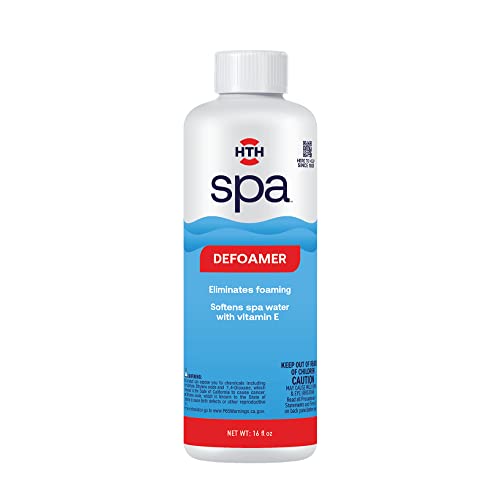
When unexpected foam appears before guests arrive, a dedicated defoamer provides immediate relief. A quick application of HTH Spa 86116, Defoamer, 16 oz knocks down surface bubbles within seconds while conditioning the water with vitamin E. This formula integrates safely with chlorine, bromine, and biguanide systems without disrupting ongoing sanitizer cycles. Simply squirt a small amount directly over the foam clusters while the jets circulate.
Defoamers provide a fast temporary cosmetic solution, but they do not eliminate the underlying organic contaminants causing the issue. If foam returns repeatedly within days, inspect and rinse your pleated filter cartridges thoroughly with clean water. Shocking the water with an oxidizing agent helps burn out the residual detergents and oils trapped in the spa. When persistent foaming continues despite shocking, draining the tub and refilling with fresh tap water becomes necessary.
Managing Jet Circulation and Cover Placement During Dosing
The mechanical operation of your hot tub during chemical application directly impacts how well products dissolve and disperse. Always turn on the low-speed or high-speed jet pumps before pouring chemicals into the water to ensure rapid mixing. Turn off all independent air controls and venturi dials located around the spa rim during dosing. Injecting air into the water raises the pH level prematurely through carbon dioxide outgassing and can blow granular chemicals out of suspension.
Leaving the spa cover open after adding any chemical treatment protects your equipment from harsh corrosive vapors. Oxidizers, chlorine shock, and acid-based pH reducers release strong gases as they react with contaminants in warm water. Trapping these chemical vapors under a closed cover degrades the underside vinyl and corrodes headrests or metal handles. Keep the cover off for at least fifteen to twenty minutes following every chemical addition.
Investing in a heavy-duty insulated spa cover protects your tub from thermal loss, but caustic chemical vapors can still cause premature wear if venting rules are ignored. High-density tapered foam cores and marine-grade vinyl barriers maintain thermal efficiency only when preserved from chemical degradation. Replacing waterlogged covers restores energy efficiency and reduces winter electrical consumption. Proper venting habits preserve the longevity of both the cover material and the underlying acrylic shell.
Purging Plumbing Lines and Fresh Water Startup Chemical Sequences
Biofilm and oily deposits accumulate deep inside internal plumbing manifolds where standard water sanitizers cannot reach. Before draining and refilling a hot tub, circulate a specialized plumbing flush like the Oh Yuk Hot Tub Cleaner and 5-in-1 Weekly Spa Care combo through the lines. This jet cleaner loosens trapped biofilm, body oils, and pipe scaling, flushing the grime directly into the tub basin. Once the flush cycle completes, drain the dirty water completely and wipe down the acrylic shell.
Refilling a hot tub requires placing the garden hose directly inside the empty filter compartment rather than the main footwell. Filling through the filter well forces water down through the internal plumbing lines and pump volutes, which purges air pockets. This simple procedure prevents pump air locks that trigger dry-fire heater faults and flow error codes upon initial startup. Fill the spa until water reaches the manufacturer fill line or covers the highest jets by at least two inches.
Once filled and powered on, allow the water temperature to reach at least eighty degrees Fahrenheit before adding startup chemicals. Cold water dissolves balancing granules poorly and produces inaccurate test strip readings. Test and balance total alkalinity first, followed by pH and calcium hardness as the water warms toward its target temperature. Finish the startup process by adding a sanitizing shock dose to establish a healthy biocide residual before the first soak.
Chemical Storage Safety and Handling Standards
Handling concentrated pool and spa chemicals requires strict adherence to practical safety protocols. Always add dry chemicals directly to the water rather than pouring water into a container of dry chemical powder. Adding water to concentrated chemicals can trigger aggressive thermal reactions, splashing, and corrosive chemical fumes. Wear protective eyewear and gloves when measuring concentrated sanitizers, pH decreasers, or clarifiers.
Never mix different chemical products together in the same measuring scoop or bucket. Even small traces of dry chlorine mixed with dry acid or shock compounds can create hazardous chlorine gas reactions or flash fires. Use separate, clean plastic scoops for each chemical product and rinse measuring cups thoroughly between uses. Store all spa chemicals in their original labeled containers inside a cool, dry, well-ventilated location away from children and pets.
Wait at least two to four hours after adding balancing chemicals or shock treatments before retesting the water. Testing too soon yields inaccurate results because chemical compounds require adequate circulation time to reach equilibrium. Check sanitizer residuals with a fresh test strip to verify that free chlorine sits below five ppm before entering the water. Patience during chemical balancing protects bathers from accidental exposure to high biocide concentrations.
Maintaining a Consistent Weekly Spa Care Routine
Establishing a predictable weekly maintenance schedule reduces the overall volume of chemicals needed to keep spa water pristine. Test sanitizer levels and pH twice weekly, making minor adjustments before small imbalances grow into severe water quality problems. Dose weekly maintenance enzymes and clarifiers on a set day to support filtration and eliminate organic oils. Rinse your pleated cartridge filters with clear water every one to two weeks to maintain unimpeded hydraulic flow.
Heavy bather loads require prompt post-soak chemical dosing to prevent water cloudiness and bacterial growth. Adding a teaspoon of granular chlorine or a cap of non-chlorine shock after each soak oxidizes bather waste immediately. Pairing sensible chemical habits with a well-maintained foldable thermal spa cover helps stabilize water temperature and limits chemical evaporation. Consistent care extends the lifespan of your spa shell, pump seals, and heater elements while keeping operating costs manageable.
Mastering chemical application transforms hot tub ownership from a stressful chore into an effortless routine. By testing your baseline parameters, balancing alkalinity and pH in sequence, and allowing proper venting time, you protect both your equipment and your family. High-quality clarifiers, defoamers, and enzyme treatments provide valuable ongoing support whenever heavy bather loads stress the water. Consistent habits and accurate dosing ensure your hot tub remains a crystal-clear sanctuary ready for daily relaxation.






Write Your Review
No reviews yet. Be the first to share your experience!