


Dragging out a manual vacuum after leaves settle or sand gathers on the floor can turn routine pool care into a chore. A robotic cleaner can take on much of that work, but the right choice depends on what your pool needs: floor-only pickup, wall and waterline scrubbing, or a cordless design that avoids a floating power cable. The question what is the best rated robotic pool cleaner has no single answer for every pool because coverage, runtime, debris capacity, and retrieval needs differ among models.
The options listed here include battery-powered robots and a corded Dolphin model, with features ranging from app controls to simple one-button operation. Product descriptions provide useful specifications, but they do not establish how a cleaner will handle every pool shape, surface, drain cover, or step arrangement. Check the listed pool type and coverage against your own pool, and treat advertised runtimes as manufacturer-stated figures rather than a promise of the same result in every cycle.
A few distinctions deserve attention before comparing models. Some cordless cleaners are listed for flat floors, while others are described as cleaning walls and waterlines; these are not interchangeable capabilities. Filter design and basket volume also affect the kind of debris a model is intended to collect and how often you may need to empty it. The guide below explains those tradeoffs and points out where the available specifications leave questions unanswered.

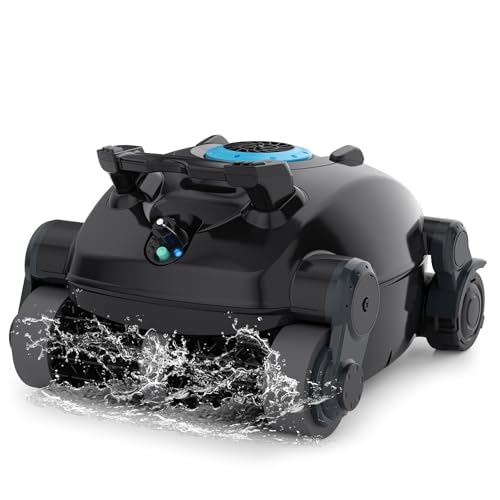


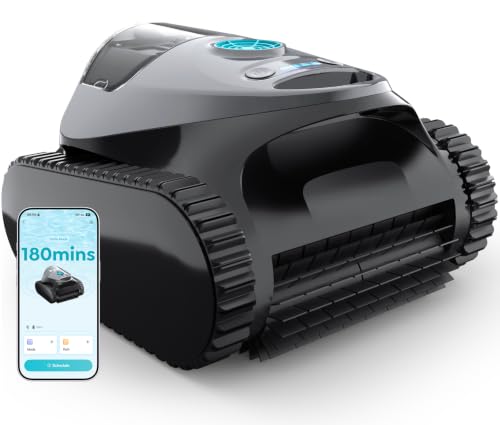

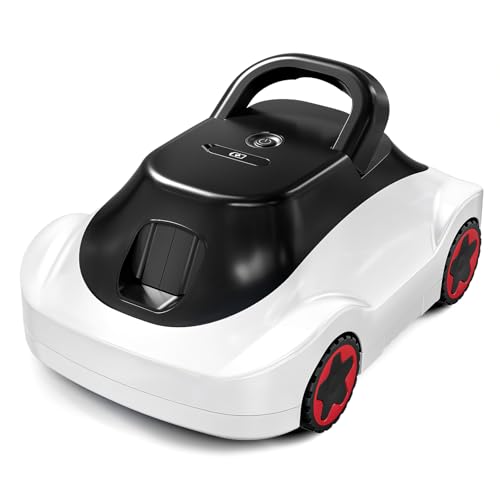

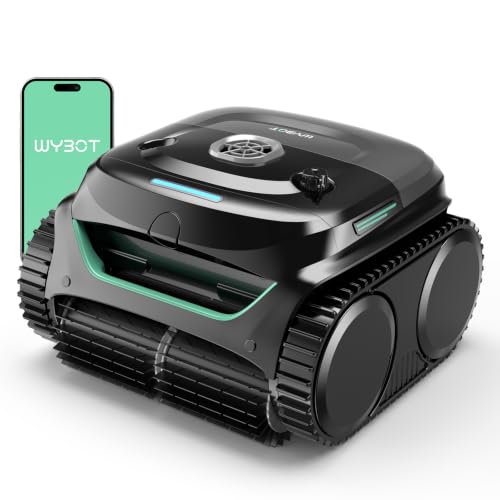
What Makes a Robotic Pool Cleaner the Best Rated Choice?
There isn’t one best-rated robotic pool cleaner for every owner. A useful match is the model whose stated pool compatibility, cleaning coverage, debris handling, and power arrangement fit the pool and maintenance routine. The products here include several cordless robots and one corded Dolphin option, so the practical decision starts with the pool itself rather than a rating number. The supplied ratings have no review counts, which means they should not be treated as strong evidence of broad owner satisfaction.
Start with the pool’s shape and cleaning needs
Check whether a model is listed for an inground pool, an above-ground pool, or both, then compare its stated coverage area with your pool. A square-foot maximum is a reference from the product description, not a guarantee that the cleaner will reach every corner in a pool with unusual geometry. Steps, slopes, raised drains, ladders, and shallow shelves can complicate movement, and the supplied listings do not describe performance on every obstacle. If your pool has several difficult transitions, avoid assuming that a claimed cleaning mode means every area will be covered.
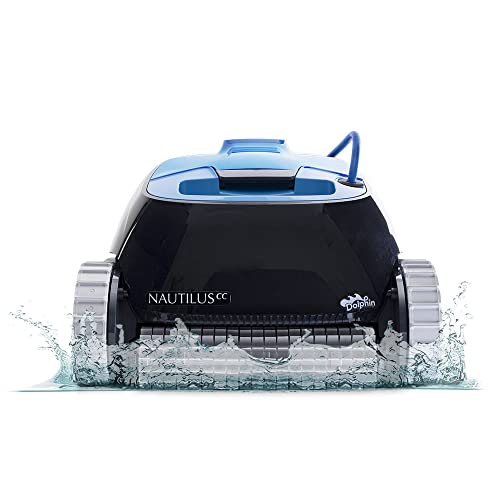
Coverage also determines whether a model suits the job you expect it to do. The OUCAXIA C5 listing describes floor cleaning for flat-bottom pools, while the Dolphin Nautilus CC is listed for wall climbing and has an active scrubbing brush. Several other products describe floor, wall, and waterline coverage, including the WYBOT C1 and Beatbot Sora 10. Those descriptions make broader cleaning claims, but narrow steps or a shallow tanning ledge may still need attention outside the robot’s cycle.
Surface compatibility needs the same care. The OUCAXIA C5 description specifically names vinyl liner, concrete, fiberglass, and mosaic tile, but that stated compatibility should not be extended to other models without documentation. Other listings do not give a complete surface list. Follow the product’s current surface guidance, especially for a delicate liner or a slick finish, and do not assume that a wall-climbing claim establishes reliable traction on every tile or fiberglass transition.
Choose coverage with realistic expectations
Floor, wall, and waterline cleaning are distinct tasks. A robot may travel up a wall without spending enough time at the waterline to remove a stubborn scum ring, and a pool with built-in steps may have spots that are hard for a cleaner to approach. Products such as the WYBOT C1, BRINBO C1, and Beatbot Sora 10 are described as covering the waterline, but the supplied information does not provide independent confirmation or a guaranteed result. Think of those features as intended coverage, then keep a manual brush available for areas the robot misses.
Navigation claims can help distinguish models, but they should be read specifically. The WYBOT C1 description lists gyroscope-based navigation and N-Path and S-Path routes; the WYBOT C2 also lists a gyroscope and intelligent navigation. The BRINBO C1 description refers to AI navigation and selectable paths. These details suggest planned routing rather than a basic untargeted approach, but no supplied data establishes that one navigation system will map every pool better than another.
Obstacle handling remains a separate question from route planning. Raised main drain covers, ladders, tight corners, and abrupt slope changes can trap or redirect a cleaner. The product information does not give specific clearance measurements or a list of drain types each robot can cross. If a cleaner repeatedly stalls at one feature, note the location and check the manufacturer’s troubleshooting instructions instead of assuming a different app mode will solve a mechanical obstruction.
Match filtration and capacity to the debris
Leaves and larger debris place different demands on a basket than fine dust or sand. The OUCAXIA C5 listing gives a 2.7-liter debris basket and a 180-micron mesh filter, while the Beatbot Sora 10 lists a 5-liter basket and optional 3-micron filtration. WYBOT C2 lists a primary 180-micron filter and an additional 10-micron filter. These are product-specific details; they should not be generalized to other models or interpreted as independent measurements of water clarity.
A larger basket may mean less frequent emptying during a leafy cycle, but the debris itself matters. Pine needles or large leaves can occupy space quickly, while fine sediment can pass through a coarser mesh. A finer filter option may be useful for smaller particles if it is available and appropriate for the model, but it may also need more attentive cleaning. The listed product details do not explain the flow or maintenance tradeoffs for every filter configuration, so check the manual before selecting an optional insert.
Access and cleanup are part of everyday ownership. The Polaris PCX 868 iQ is described with an accessible canister and transparent window, while the Dolphin Nautilus CC has top-load filter access. Several cordless listings identify washable or reusable filtration, but the exact construction differs by model. Rinse only as directed, inspect the filter for trapped debris, and disconnect power before servicing any powered equipment.
Weigh cordless convenience against charging and retrieval
Cordless models avoid a floating power cable in the pool, but they operate within a battery cycle and need recharging. Listed runtime varies: the ROBOKLEEN X1 gives up to 100 minutes, WYBOT C1 up to 160 minutes, and the C1 models from Letexpool and BRINBO state up to 180 minutes under specified modes or conditions. Beatbot Sora 10 lists up to 300 minutes. These are manufacturer-stated maximums, not a head-to-head comparison or a guarantee for every pool, cleaning mode, or battery condition.
Charging time can influence how readily you can run another cycle. WYBOT C1 lists a four-hour charge, while the Letexpool C1 states a 2.5-hour full charge; the supplied details do not give a charging duration for every option. A longer advertised runtime may suit a larger pool, but it is only meaningful if the stated coverage matches your pool and you can retrieve the cleaner conveniently. Consider where it will charge and store between uses, and follow the product’s instructions for battery care.
Retrieval is easy to overlook when comparing features. The ROBOKLEEN X1 is listed at 8.6 pounds and has a quick-drain flap, while the WYBOT B1 is listed at 14.3 pounds. Beatbot Sora 10 describes parking at the waterline for access after a cycle, and the OUCAXIA C5 describes auto-parking near the pool wall. These features may help with removal, but they do not remove the need to lift carefully or use the supplied retrieval accessory as directed.
A depleted cordless unit may stop away from the wall, depending on its design and operating state. The listings do not promise that every model will return to an accessible position in every circumstance. Check whether a retrieval hook is included, what the parking feature actually does, and how the manufacturer says to retrieve the robot from a deep area. Do not enter the pool or improvise a retrieval method that conflicts with the safety instructions.
Decide whether app controls are useful
App functions vary from simple mode selection to more involved remote control. Polaris PCX 868 iQ lists Wi-Fi connection through iAquaLink, with start and stop controls, mode selection, cycle timing, and a lift function. WYBOT models describe app control, scheduling, or cleaning mode selection, and Beatbot Sora 10 lists Wi-Fi or Bluetooth operation. These features can make remote adjustments convenient, but they do not replace checking the pool or cleaning the filter after a cycle.
App dependence may not suit everyone. The ROBOKLEEN X1 is described as a one-button cleaner without setup, syncing, or programming, while some models require settings to be selected before entering the water. That distinction matters if you prefer a simple start or want to adjust a route from a phone. Read setup requirements carefully because a mode change may not be available once the cleaner is submerged.
Connectivity also isn’t the same as autonomous obstacle recovery. Remote steering or cycle controls cannot necessarily free a robot wedged against a drain or ladder. Consider which controls you’ll actually use, whether the app requires a particular connection, and whether the cleaner has an accessible physical control unit. The supplied descriptions do not establish how app features perform with every home network or mobile device.
Understand the corded option’s different tradeoffs
The Dolphin Nautilus CC is a corded robotic cleaner, unlike the battery models in this group. Its listing describes plug-and-play operation, wall climbing, an active scrubbing brush, top-load filter access, and a two-hour cleaning cycle. A corded setup removes the need to recharge a robot between cycles, but the cable needs suitable handling and the power supply must be used according to its instructions. The supplied information does not specify cable length or an anti-tangle swivel, so verify reach and cable-management details before purchase.
The Polaris PCX 868 iQ is also a corded robotic option, with Wi-Fi controls, double helix brushes, an easy-clean canister, and an automatic lift feature described in its listing. Its higher feature count does not by itself establish a better fit than a simpler model. Owners should account for access to a suitable protected power connection and follow the manufacturer’s required placement and electrical guidance. Never pull a cord to retrieve a robot, and don’t service powered equipment while it is connected.
Robotic cleaners differ from suction-side and pressure-side cleaners in how they connect to pool circulation, but the products covered here are robotic units. The supplied listings do not provide pump flow requirements or booster-pump specifications for these robots, so there is no basis to compare them on those measures. If replacing an older cleaner, identify whether it uses pool plumbing before assuming a robotic model will connect the same way. A self-contained robotic design may simplify plumbing considerations, but the exact electrical and operating requirements still matter.
Compare the listed models by the job they suit
For a flat-bottom pool and a lower-complexity routine, the OUCAXIA C5 listing emphasizes floor cleaning, a large debris basket, and use in above-ground or inground flat pools up to its stated area. It is not the clearest match if wall and waterline cleaning are priorities because its listed coverage centers on the floor. The ROBOKLEEN X1 is described for inground and above-ground pools and lists wall climbing, a stated area limit, and quick-drain handling. Its stated cycle time is shorter than several other cordless models, so pool size and desired coverage should guide expectations.
For broader listed coverage and app functions, WYBOT C1 describes floor, wall, waterline, and step cleaning, with a 160-minute maximum runtime and app scheduling. WYBOT C2 lists a 180-minute maximum runtime, multiple cleaning modes, and dual filtration with a finer optional level stated in its specifications. The WYBOT B1, by contrast, lists up to 120 minutes and a pool area limit, plus five cleaning modes. Check each model’s actual pool-type and surface requirements rather than assuming related brand names mean identical capabilities.
Letexpool C1 and BRINBO C1 descriptions both highlight cordless operation, multiple modes, and a maximum runtime of up to 180 minutes, but their stated charging, app, filtration, and warranty details differ. Beatbot Sora 10 stands out in the supplied information for its stated runtime, larger basket, shallow-area coverage, and waterline parking. Polaris PCX 868 iQ emphasizes app operation and a lift system, while Dolphin Nautilus CC presents a more straightforward corded setup. These distinctions help narrow a shortlist, but the data does not support declaring one product universally superior.
Ratings alone are a weak tie-breaker here because the supplied rating figures are paired with zero reviews. A displayed high rating with no review base offers little information about reliability, surface behavior, or customer support. Check current retailer information and the manufacturer’s warranty and replacement-part availability before buying. Also confirm that the exact model listing matches the pool type and coverage you need, since similar model names do not guarantee identical specifications.
Keep ownership and safety in the decision
Routine care includes emptying the debris basket, rinsing filters as directed, and checking brushes and moving parts for trapped leaves or hair. Cordless units need charging and dry storage according to their instructions; corded units need their cable and power supply kept in the condition and placement specified by the manufacturer. Avoid leaving equipment in water during chemical shock treatment unless the manufacturer explicitly permits it. Balanced pool water and adherence to product instructions help avoid exposing plastics, seals, or electrical components to conditions they are not designed for.
For corded robots, follow the manual’s electrical precautions and verify that the power arrangement provides the required GFCI protection. Keep electrical equipment in the placement specified by the manufacturer, and disconnect the power source before cleaning or inspecting the unit. Never swim while a powered cleaner is operating unless its instructions explicitly permit it. Safe setup matters more than app convenience or a claimed cycle feature.
Think about replacement parts before a cleaner needs them. Brushes, filters, batteries, and other components can differ by model, and the product information supplied here does not establish long-term availability or replacement costs. A warranty statement is useful only when its coverage, duration, exclusions, and service process are clear in the current documentation. Save the model details and consult the manufacturer when you need a compatible replacement component.
The most sensible choice is the cleaner whose documented coverage and handling suit your pool, not simply the product with the highest displayed rating. Match pool type and shape first, then compare floor versus wall and waterline coverage, filter capacity, runtime or cord arrangement, and retrieval needs. Treat maximum runtimes and feature claims as manufacturer specifications, and verify unanswered surface, obstacle, and service questions before ordering. That approach gives you a practical shortlist without assuming any robot can replace every manual touch-up.




Write Your Review
No reviews yet. Be the first to share your experience!