

Sub-zero winter temperatures present serious mechanical challenges for backyard spa owners when plumbing lines and pumps risk freezing during severe cold snaps. When water turns to ice inside internal manifolds, expansion can crack rigid PVC pipes, ruin expensive pump wet ends, and damage titanium heating elements. Homeowners wondering how to protect hot tub from freezing often face rising electrical costs or power outage anxieties during the coldest months of the year. Installing energy-efficient ground barriers and inspecting equipment seals helps safeguard mechanical components before bitter winter storms arrive.
Maintaining consistent thermal retention also requires pairing a primary insulated hard cover with protective patio spa covers to shield cabinet hinges from drifting snow and driving rain. Taking proactive steps to maintain water circulation, test backup power solutions, and seal micro-leaks ensures your hydrotherapy system operates reliably throughout winter. A sensible winter maintenance plan keeps your equipment running smoothly while protecting your financial investment from sudden plumbing failure.

Pros
- Cost-effective initial troubleshooting option for slow, hard-to-locate water seepage
- Simple dosing ratio of 1 ounce per 500 gallons makes application straightforward
- Dual application paths accommodate both hidden plumbing leaks and visible surface cracks
- Compact 1-pint bottle stores easily alongside routine hot tub water care supplies
Cons
- Intended solely for minor weeping or micro-fissures, not major pipe splits or failed pump seals
- May require removing or bypassing filter cartridges during circulation to prevent filter clogging
- Severe structural cracks or high-pressure plumbing breaks will still require mechanical repair
SpaChoice Premium Seal A Leak provides a specialized chemical repair option for hot tub owners who are losing water to minor shell fissures or internal plumbing seepage. Identifying the precise location of a leak inside an insulated spa cabinet can be frustrating, often requiring owners to pull away side panels or dig through spray foam insulation. This concentrated liquid sealant offers an accessible alternative, allowing spa owners to treat minor water loss directly through the water column without immediately dismantling their hot tub.
The real-world usefulness of this leak sealer centers on its adaptable application procedure and economical dosage rate. Designed around a ratio of 1 ounce per 500 gallons of spa water, a single 1-pint bottle provides ample solution for typical portable spas, which usually hold between 300 and 450 gallons. When the exact origin of the leak is unknown, the solution can be added directly into the skimmer so the circulation pump distributes it across internal lines and fittings. If a crack or leak site has already been identified on the acrylic shell or around a jet fitting, pouring the measured dose directly over the targeted area allows the product to gravitate toward the point of escape.
In terms of composition and handling, SpaChoice packages this formulation in a standard 1-pound, 1-pint container measuring roughly 3 by 6 by 10 inches. Because the formula relies on physical sedimentation and chemical coagulation at the leak boundary, proper spa operation during treatment is essential. Many hot tub owners find that removing the spa filter cartridge prior to circulating the product prevents the filter media from trapping the sealant before it can settle into micro-fissures, preserving both filtration efficiency and product performance.
Routine spa ownership requires realistic expectations regarding what chemical leak sealers can and cannot accomplish. SpaChoice Seal A Leak is engineered specifically for minor weeping, hairline acrylic cracks, and small joint seepage where pressure and flow allow the compound to bridge the gap. It is not designed to fix catastrophic freeze damage, cracked manifold bodies, severed PVC pipes, or mechanical pump seal failures that experience high direct pressure.
For homeowners, vacation-rental hosts, and spa owners faced with mysterious minor water drops, SpaChoice Seal A Leak represents a low-risk, practical first step in leak management. Before purchasing, verify that your daily water loss is gradual rather than a rapid drain, and plan to follow dosage instructions carefully while monitoring your water level over a 24 to 48-hour period.
Accurate dosing is essential for achieving optimal results with SpaChoice Seal A Leak. The manufacturer recommends a baseline ratio of 1 ounce of sealant per 500 gallons of water capacity. For an average residential spa holding approximately 350 to 400 gallons, slightly less than one fluid ounce is typically required per treatment cycle.
If the location of the water loss is undetermined, adding the measured dose through the skimmer while the low-speed circulation pump is active helps draw the sealant through the internal manifold and plumbing lines. If the leak is visible, turning off the jets and slowly pouring the dose directly over the affected seam or crack allows the denser liquid to draw into the opening. Removing the filter cartridge during application is a recommended precautionary practice to prevent the filter fabric from capturing the active sealing agents.
Distinguishing between minor plumbing weeping and major component failure helps determine whether a liquid sealer is the appropriate remedy. Gradual water level drops of an inch over several days often indicate minor joint seepage, loose jet gaskets, or micro-cracks where a product like SpaChoice Seal A Leak can be effective.
Rapid water loss where the hot tub loses several inches overnight generally indicates a cracked pipe, a damaged union, or a failed pump wet-end seal. In those circumstances, liquid sealants will wash out with the high-velocity flow, and physical inspection of the equipment bay and plumbing lines will be necessary to perform permanent mechanical repairs.

Pros
- Heavy-duty 600D composite canvas resists harsh weather, sunlight exposure, and airborne debris
- Mechanical 360-degree ratchet tie-down secures the skirt much more firmly than basic elastic hems
- Seamless center pattern prevents stitch leaks across the flat surface of your spa
- Integrated dual side vents promote steady airflow to reduce trapped condensation
- Easy for a single person to handle and drape over an existing hard cover
Cons
- Uninsulated fabric shell cannot replace a structural foam hard cover and provides no thermal retention on its own
- Rainwater can collect and puddle if the underlying hard cover has a flat or sagging surface
- Sized at 85 by 85 inches, creating a looser fit on tubs measuring closer to the 81-inch minimum
The QH.HOME 85 x 85 Waterproof Hot Tub Cover Cap is designed specifically as a protective outer shell for hot tub owners who want to shield their factory hard cover from direct environmental wear. Many hot tub owners find that exposure to relentless sun, freezing rain, wet snow, and falling tree debris causes standard vinyl hard covers to fade, crack, and eventually absorb water. This product is not an insulated replacement cover and contains no foam core. Instead, it acts as a tough secondary barrier that drapes directly over your existing insulated hard cover, making it an excellent investment for backyard spa owners, mountain cabin operators, and homeowners in challenging outdoor climates.
In practical everyday use, the cover measures 85 inches long by 85 inches wide and is rated to fit square hot tubs measuring between 81 and 85 inches across. The seamless top design is a notable advantage, as traditional stitched seams on the upper deck often create puncture paths where pooling water can seep through over time. Coupled with high-density waterproof fabric and sealed perimeter seams, this protector keeps dirt, pine needles, and precipitation off the primary vinyl lid. Dual built-in side air vents allow air circulation beneath the canvas, helping disperse trapped condensation while reducing the parachute effect during high wind gusts.
Material construction centers around a durable 600D polyester composite canvas fabric with tear-resistant qualities. The heavy-duty woven exterior stands up against UV degradation, which is one of the most common causes of vinyl brittleness and seam splitting on hot tub covers. Rather than relying on flimsy corner elastic that can stretch out after a single season, QH.HOME equips this cap with a 360-degree ratchet tie-down system. By tightening the perimeter ratchet strap around the hot tub cabinet, the protector locks firmly in place to prevent the wind from lifting the skirt or blowing the cover across the yard.
Ownership and daily handling remain straightforward due to the manageable 4.14-pound product weight. Draping the lightweight cap over the hot tub before an oncoming storm or during weekday non-use takes only a minute or two, and releasing the ratchet mechanism allows quick removal when it is time for an evening soak. When not in use, the flexible canvas folds compactly for storage inside a deck box or patio cabinet. Maintenance is minimal, requiring only an occasional rinse with a garden hose to clear away dust, pollen, or fallen leaves.
A realistic limitation of this product is that it possesses zero thermal insulation value and cannot support heavy downward loads on its own. It must be paired with an existing, rigid hard cover to function properly. Furthermore, if your underlying hard cover is already bowed or sagging in the center, rainwater or melting snow will naturally pool on top of the canvas, requiring manual sweeping or draining. Owners with tubs measuring close to 81 inches should also expect some excess fabric around the perimeter compared to a tight, custom-tailored fit.
For owners of square spas between 81 and 85 inches looking for an affordable way to extend the lifespan of an expensive hard cover, the QH.HOME Cover Cap provides dependable, cost-effective weather protection. Before ordering, carefully measure the outer perimeter of your existing hard cover from edge to edge to confirm that your dimensions fall within the recommended 81-to-85-inch range.
Accurate sizing is essential when selecting a hot tub cover cap. The QH.HOME protector measures 85 inches by 85 inches, engineered specifically to fit square spa shells and hard covers measuring from 81 inches up to 85 inches. If your spa dimensions exceed 85 inches, the cap will not drape over the edges properly, while tubs smaller than 81 inches will experience noticeable bagging around the skirt.
Weather resistance is reinforced through the combination of 600D composite canvas and an integrated mechanical ratchet tie-down. Unlike simple drawstring or elastic borders that frequently pull loose in stormy conditions, the 360-degree ratchet can be cinched down tightly beneath the lip of the cabinet. This anchor system, combined with dual side vents that equalize internal pressure, ensures that the protector stays anchored during blustery days without blowing away or violently flapping against the cabinet panels.
Caring for the 600D polyester canvas is simple and requires only basic routine maintenance. Periodically sweep off accumulated leaves, twigs, and dry debris using a soft-bristle broom to keep the dual side air vents clear of obstructions. When dirt or bird droppings accumulate, rinse the cover with a garden hose and clean the surface using mild soap and warm water. Avoid harsh bleach, petroleum-based solvents, or abrasive scouring pads, as these chemicals can degrade the water-resistant coating.
Before folding and storing the cover cap for extended periods, ensure the fabric is completely dry to prevent surface mildew from developing inside the storage bag or deck box. After significant winter snowfall, gently clear heavy snow accumulations using a push broom rather than sharp metal shovels to protect both the protective cap and the underlying hard cover structure.
Pros
- Thick 2/5-inch high-density EVA foam provides superior puncture protection compared to standard thin ground tarps
- Interlocking tile format makes transport, setup, and seasonal off-season storage simple for a single person
- Forms an effective thermal break that helps retain water temperature on cold garage floors, stone pavers, or concrete
- Generous 78-inch circular dimension matches standard round inflatable spa footprints closely
Cons
- Interlocking puzzle seams require a smooth, flat foundation to keep tiles from pulling apart during tub filling
- Not suitable for larger portable spas or square models measuring over 78 inches in width
- EVA foam will naturally develop surface compressions over time under the massive weight of filled water
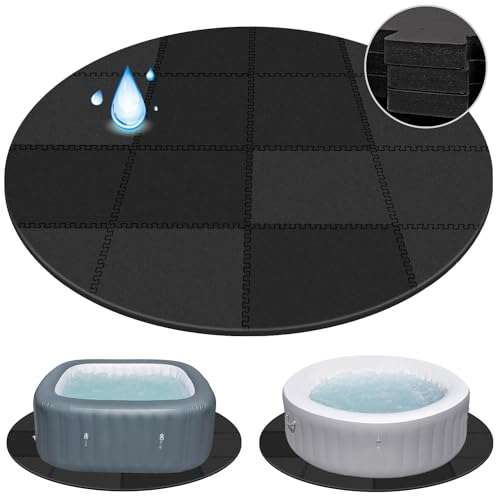
The Oyrlize 78-Inch Round Hot Tub Mat is a specialized ground protection pad designed specifically for portable and inflatable spas. Sized to accommodate round hot tubs measuring up to 78 inches in exterior diameter, this accessory addresses two common vulnerabilities that inflatable spa owners encounter: ground friction punctures and bottom heat dissipation. It is particularly well suited for homeowners setting up portable tubs on abrasive concrete patios, paver decks, gravel-adjacent pads, or garage slabs where rough surfaces can easily compromise thin vinyl liners.
Placing an inflatable hot tub directly onto bare concrete or hard dirt allows cold ground temperatures to constantly sap heat from the water through conduction. This pad utilizes 2/5-inch high-density EVA foam to establish an insulating thermal barrier that helps slow downward thermal transfer during cool weather. In addition to aiding temperature retention, the foam provides substantial underfoot cushioning, turning a hard, unforgiving ground surface into a soft, comfortable floor inside the spa.
In terms of build quality, the high-density EVA foam material offers significantly better tear resistance, puncture defense, and durability than standard plastic tarps or thin felt cloths. The foam is inherently waterproof and resists moisture absorption from splash-out. Furthermore, both sides of each tile feature a frosted anti-slip texture engineered to maximize surface friction. This textured finish prevents the pad from sliding on smooth deck boards and helps quiet pump and motor vibrations transmitted through the ground.
Setup is straightforward thanks to the puzzle-style interlocking edges. A single person can assemble the full circular footprint in just a few minutes without tools or adhesives. When winter approaches or it is time to drain and store the hot tub, the tiles pull apart cleanly and stack into a compact footprint that takes up minimal space on garage shelving. Routine maintenance is equally simple, requiring only a periodic rinse with a garden hose to clear away dirt, grass, and outdoor debris before air drying.
Prospective buyers should be mindful of sizing and site preparation constraints. Because the mat forms a 78-inch circle, it will not fully protect oversized round spas or square models with wider dimensions. The subfloor beneath the mat must also be properly cleared and leveled; large rocks, pronounced roots, or significant slope can cause the puzzle joints to separate once the heavy weight of water settles onto the tiles.
For owners of Coleman, Intex, or Bestway SaluSpa models seeking an affordable way to safeguard their investment and improve heating efficiency, the Oyrlize protective pad is a sensible, high-value addition. It delivers noticeable comfort and essential puncture defense across everyday backyard setups. Before purchasing, verify your spa exterior diameter when fully inflated to ensure it fits neatly within the 78-inch circular perimeter.
Inflatable hot tubs lack the rigid insulated floor bases found on permanent acrylic spas, leaving the vinyl bottom vulnerable to heat drain and abrasion. The 2/5-inch dense EVA foam core acts as a protective buffer, absorbing mechanical stress from uneven subsurfaces while shielding the liner from sharp stones and grit.
From an energy perspective, concrete slabs and outdoor paving stones act as massive heat sinks. By placing this closed-cell foam pad between the tub bottom and the cold ground, conductive heat loss is reduced, helping your portable heater maintain target soaking temperatures more efficiently during chilly evenings.
This circular pad is engineered specifically for round portable hot tubs with an outer inflated diameter of 78 inches or smaller. Compatible models include popular Bestway SaluSpa units such as the Miami, Cancun, Fiji, Madrid, Zurich, St. Lucia, Milan, Palm Springs, and Tahiti, alongside standard Coleman and Intex round tubs.
To guarantee complete edge-to-edge coverage, always measure your hot tub across the widest outer edge when fully inflated before purchasing. Ensuring the entire tub footprint rests within the 78-inch boundary prevents the bottom seams from hanging over the foam perimeter.

Pros
- Constructed with rugged 600D Oxford fabric and reinforced PU backing for reliable weather and UV protection
- Multi-point securing system features two perimeter drawstrings and four corner buckles to resist high winds
- Built-in air vents encourage air circulation to minimize underneath condensation and stale moisture
- Generous 20-inch side skirt offers broader cabinet coverage than standard shallow cover caps
- Integrated top corner handles make pulling the cover on and off fast and manageable
Cons
- Serves as a protective fabric cover cap and does not provide thermal foam insulation to retain water heat
- May fit loosely or bunch on tubs closer to 82x82 inches or 7x7 feet without careful tightening of all drawstrings
- Water can pool on the flat fabric surface if placed over a sagging or non-tapered hard cover beneath
The GARPROVM 85 x 85 Hot Tub Cover is an exterior fabric cover protector designed to shield square spas and their underlying insulated hard covers from outdoor environmental damage. Made for homeowners, cabin operators, and patio spa users, this slip-on protector acts as a sacrificial barrier against rain, falling leaves, tree sap, snow accumulation, and harsh ultraviolet sunlight. It is specifically tailored for owners who want to extend the lifespan of an expensive rigid thermal cover or keep their spa cabinet clean between soak sessions without investing in a costly full replacement lid.
Achieving the right fit requires measuring both your tub outer cabinet dimensions and the thickness of any existing hard cover you intend to leave underneath. Measuring 85 inches long by 85 inches wide with an extra-deep 20-inch skirt drop, this cover fits square spas ranging from 82 x 82 inches up to 85 x 85 inches, including common 7 x 7-foot footprints. The deep 20-inch side skirt extends well past the rim of standard thermal lids to shelter the upper portions of your spa cabinet. Built-in air vents promote steady cross-ventilation underneath the fabric, which helps mitigate moisture retention, unpleasant odors, and damp condensation buildup during humid or fluctuating weather.
The build quality centers around heavy-duty 600D Oxford polyester fabric backed by a reinforced polyurethane (PU) interior coating. Double-stitched seams reinforce critical stress points, while the contrast orange stitching adds visual structure across the black fabric. The PU backing provides a water-resistant barrier designed to stay pliable through seasonal temperature shifts without cracking or peeling. At a manageable weight of under 6 pounds, the protector is lightweight enough for solo operation while maintaining sufficient fabric density to resist tearing against rough cabinet corners.
Daily handling and routine installation are simplified by two sturdy grab handles situated on the upper corners, allowing a single person to glide the cover across the spa smoothly. For wind-prone yards and open decks, the cover utilizes a multi-tiered anchoring system consisting of dual drawstrings positioned at both the mid-section and the bottom hem, complemented by four heavy-duty corner buckle straps. Tightening these tension points creates 360-degree retention, preventing strong gusts from catching underneath the skirt and turning the cover into an unwieldy sail.
Buyers must understand that this protector is not a substitute for a rigid, foam-core insulating hot tub cover. It does not provide thermal R-value insulation, and it cannot support heavy structural loads such as standing snow or human weight. When installed over an existing hard cover with a damaged or sagging center, rainwater may pool in low spots on the fabric surface, necessitating manual clearing or the use of an underlying support object to encourage proper runoff. Owners of smaller 82-inch tubs should also expect extra fabric around the perimeter that requires cinching down neatly with the dual drawstrings.
For owners of 7-foot to 7-foot-1-inch square spas seeking an economical defense against sun bleaching, bird droppings, and blowing dirt, the GARPROVM 85-inch cover cap delivers dependable everyday utility. Before purchasing, verify that your hot tub or existing hard lid measures 85 x 85 inches or smaller, and ensure that a 20-inch drop accommodates your cabinet height without dragging on the surrounding deck.
The GARPROVM cover protector measures exactly 85 inches in length, 85 inches in width, and features a 20-inch side skirt drop. It is engineered for square spas and can accommodate hot tubs measuring 82 x 82 inches, 83 x 83 inches, 84 x 84 inches, or 85 x 85 inches (including common 7 x 7-foot configurations).
Before purchasing, measure the widest exterior dimensions of your hot tub cabinet or your existing hard cover from edge to edge. Ensure your spa does not exceed 85 inches in either horizontal direction, as the 600D Oxford material does not stretch. For tubs smaller than 85 inches, use the adjustable perimeter drawstrings to gather and secure any excess fabric.
Outdoor exposure presents constant challenges from blowing wind, driving rain, and degrading sunlight. The GARPROVM protector addresses high-wind environments using a comprehensive anchoring setup that includes four corner buckle straps and dual perimeter drawstrings positioned at both the mid-point and the bottom hem.
The heavy-duty 600D Oxford fabric with reinforced PU coating creates a robust defense against rain and UV degradation. Additionally, built-in air vents encourage air exchange beneath the fabric, relieving internal air pressure during windy days and reducing condensation that could otherwise collect against the spa cabinet or thermal lid.
Maintaining the GARPROVM hot tub cover cap requires minimal effort thanks to its smooth PU-coated Oxford surface. Regular maintenance involves sweeping away dry leaves, needles, and patio debris using a soft-bristled brush or clean broom.
For accumulated dirt, bird droppings, or pollen, simply wipe down the exterior with a damp cloth or rinse it gently with a garden hose using cool water and mild soap. Avoid harsh chemical cleaners, abrasive scrubbing pads, or machine washing, as these can degrade the protective PU inner coating and weaken the seam stitching over time.

Pros
- Lightweight and easy to handle at 4.4 pounds, making it accessible for older users or anyone who doesn't want to wrestle with heavy cover accessories
- Adjustable buckle straps and corner zippers help secure the cap against wind, which is a practical advantage for exposed patios, decks, and windy locations
- Air vents on both sides may reduce condensation and moisture trapped between the cap and the hard cover underneath
- Double-stitched seams with sealant add durability at stress points where outdoor cover caps commonly fail first
- At the listed 85x85-inch size, this cap may fit a range of 7-foot square spas when paired with a hard cover, offering flexibility across multiple spa brands
Cons
- This is a cover cap or protector only - it cannot insulate or replace a hard hot tub cover, and the manufacturer explicitly states a hard cover or boards are still required underneath
- The 18-inch height dimension means buyers need to verify that their hard cover's peak height plus spa cabinet clearance works with this cap's drape length
- Long-term waterproofing of fabric coatings can degrade with extended UV and weather exposure, so the cap itself may eventually need replacement depending on climate severity
The iBirdie 85x85-inch outdoor hot tub cover is a cover cap - a protective outer shell that goes over your existing hard spa cover to shield it from weather, UV, and debris. This is not a replacement hard cover and provides no insulation on its own. The manufacturer is clear that you still need your hard cover or boards underneath. That distinction matters for first-time buyers who might assume this alone will keep their spa warm. What it does do is add a secondary weather barrier that can extend the useful life of your hard cover by keeping direct rain, snow, tree debris, pollen, and sun off the surface.
The listed dimensions are 85 inches long by 85 inches wide with an 18-inch drop height, making it sized for square or near-square hot tubs in the 7-foot range. Because this cap drapes over the hard cover and down the sides of the spa cabinet, buyers should measure not just the spa shell but the total footprint including the hard cover sitting on top. The product listing recommends ordering a cover cap that is longer and wider than your hot tub, so if your spa with its hard cover measures close to 85 inches on either side, you may find the fit too snug or the side drape too short. Measure carefully before ordering.
Build quality centers on a heavy-duty fabric with a waterproof coating, double-stitched seams, and seam sealant. These construction details are aimed at preventing water intrusion and tearing at stress points. The four adjustable buckles and waterproof zippers at each corner are designed to lock the cap down against the spa cabinet, which is a meaningful feature for owners in windy areas where a loose cover cap can act like a sail and blow off. Air vents on both sides are intended to let trapped moisture escape, reducing the chance of mildew or condensation buildup between the cap and the hard cover beneath it.
Day-to-day handling is straightforward. At 4.4 pounds, the iBirdie cap is light enough for one person to remove, fold, and set aside before opening the spa. Two fabric handles help with positioning. For owners who use a cover lifter on their hard cover, you'll want to remove this cap before engaging the lifter - it's not designed to stay on during the lifting process. That adds an extra step to your spa-entry routine, but it's a minor tradeoff for the added weather protection.
Realistic limitations include the fact that no fabric-based cover cap stays waterproof indefinitely. UV exposure, temperature cycling, and physical wear will eventually degrade the waterproof coating, especially in high-UV climates like the Southwest or in areas with heavy seasonal snow loads sitting on the cap for extended periods. The cap protects your hard cover from these same forces, but the cap itself is a consumable item over time. Additionally, the 18-inch listed height may or may not provide adequate drape for all spa cabinet heights, so verifying your specific setup dimensions is important.
The iBirdie 85x85-inch cover cap is a practical purchase for hot tub owners who want to add a layer of weather protection over their existing hard cover without spending on a full replacement cover. It's well-suited for owners dealing with tree debris, seasonal pollen, rain, or snow who want to keep their hard cover cleaner and potentially extend its lifespan. Before ordering, measure your spa's total width and depth with the hard cover in place, and confirm that the 18-inch drop height works for your cabinet. This cap works best as a companion to a hard cover in good condition - not as a substitute for one that's already waterlogged or failing.
The iBirdie cover cap measures 85 x 85 inches with an 18-inch drop height. These dimensions are designed to fit over a hard cover sitting on a square hot tub in the 7-foot range. The key measurement isn't just the spa shell - it's the total footprint of the spa with the hard cover on top, including any overhang the hard cover creates beyond the cabinet edge. If your spa plus hard cover measures 82 to 84 inches per side, you'll likely get reasonable drape on the sides. If it measures 85 inches or more, the cap may sit flat without much side coverage.
The 18-inch drop height determines how far down the sides of your spa cabinet the cap will hang. Taller cabinets may see less coverage at the base, while shorter cabinets may have excess material. The adjustable buckle straps can help cinch the cap snug regardless, but the overall drape depends on your specific spa dimensions. Always measure before ordering rather than relying on your spa's marketed size, since actual dimensions can vary from model to model.
The iBirdie cover cap is positioned as a weather barrier against rain, snow, sun, and falling debris. The waterproof coating and sealed seams are designed to shed water rather than absorb it, which can help keep the hard cover underneath dry and clean. For owners in rainy climates like the Pacific Northwest or snowy regions in the Northeast and Midwest, a cover cap like this can reduce the amount of standing water and snow that sits directly on the hard cover's vinyl surface.
In high-UV environments like Arizona, Texas, or Southern California, the cap takes the brunt of UV degradation instead of the hard cover's vinyl, potentially extending the hard cover's appearance and surface integrity. However, the cap's own waterproof coating and fabric will degrade faster in intense UV conditions. Owners in these climates should inspect the cap periodically for signs of coating failure, such as water soaking through rather than beading off. Replacing the cap when it starts to fail is far less expensive than replacing a full hard cover.
Wind is one of the biggest threats to lightweight cover caps, and the iBirdie addresses this with four adjustable buckle straps and waterproof zippers at each corner. These features are designed to hold the cap against the spa cabinet so it doesn't lift or blow off in gusty conditions. For owners on elevated decks, open patios, or in regions prone to strong winds, these securing mechanisms are a meaningful feature compared to cover caps that rely on elastic hems alone.
That said, no lightweight fabric cover cap can withstand extreme wind events. In areas with frequent high winds or storm-force gusts, it's worth checking the buckles and straps periodically for wear and ensuring they remain tight. If a buckle fails or a strap loosens, the cap can catch wind and potentially damage itself or the hard cover underneath. Routine inspection of the closure hardware takes only a moment and can prevent problems.
Protecting Your Spa from Freezing Temperatures and Winter Damage
Understanding how to protect hot tub from freezing requires a combination of continuous water movement, secondary insulation layers, and reliable weatherproofing. Water expands by roughly nine percent as it solidifies into ice, generating intense hydraulic pressure that can rupture internal manifolds and split acrylic shells. Keeping a hot tub safe during freezing weather involves either maintaining active heating cycles or performing a meticulous winterization procedure to evacuate every drop of moisture. By setting up the proper defenses before arctic air arrives, owners can prevent thousands of dollars in structural repairs and equipment replacements.
The Thermodynamics of Spa Freeze Protection and Water Circulation
Water in motion freezes at a significantly slower rate than stagnant water inside uninsulated plumbing. Most modern electronic spa packs feature integrated automated freeze protection sensors that continuously monitor ambient plumbing temperatures. When internal water sensors detect temperatures dropping below forty degrees Fahrenheit, the control board automatically engages the low-speed circulation pump and the electric heating element. This continuous circulation pushes warm water through the heater barrel, distribution manifolds, and hydrotherapy jets to prevent ice crystals from lodging in narrow pipes.
A common mistake among newer hot tub owners is turning the thermostat down too low during winter to save on electrical consumption. While setting the water to eighty degrees Fahrenheit might seem economical, it dramatically shrinks the safety buffer if a severe storm triggers a localized power outage. In sub-zero weather, water starting at eighty degrees can reach freezing temperatures within hours, whereas water maintained at one hundred degrees provides days of thermal inertia. Maintaining a standard operating temperature between ninety-eight and one hundred and two degrees Fahrenheit creates a vital heat sink that shields internal plumbing from sudden thermal shock.
Filtration cycles also play an indispensable role in maintaining uniform water temperature throughout the entire vessel. Program your spa controller to run filtration cycles for at least two to four hours twice daily, or leave continuous low-speed circulation active if your unit utilizes a dedicated circulation pump. Regular circulation prevents cold spots from forming around isolated perimeter footwells or exposed external drain fittings. Keeping water flowing uniformly guarantees that heated water reaches every nook of the internal plumbing network.
Enhancing Cabinet and Ground Insulation Against Cold Conduction
Ground conduction represents an often-overlooked source of severe heat loss, especially for portable and inflatable spa installations. Placing an outdoor spa directly onto frozen concrete slabs, wet stone pavers, or frozen soil accelerates heat transfer away from the water basin. Using dense base barriers like the Oyrlize 78 Inch Round Hot Tub Mat provides a thermal barrier that separates the spa bottom from ice-cold surfaces. This extra-thick interlocking EVA foam pad helps reduce ground-level heat dissipation while cushioning the base against abrasive contact.
Portable hot tubs and inflatable models benefit tremendously from ground pads because their thin bottom floors lack the structural framing found in acrylic spas. When cold air circulates beneath an uninsulated tub floor, heating elements must run almost constantly to maintain basic soaking temperatures. An interlocking foam pad insulates against ground frost, lowers monthly electricity draw, and stabilizes base warmth during bitter cold spells. Disassembling and cleaning the modular puzzle tiles takes minimal effort once spring arrives, making it a flexible seasonal upgrade.
For hard-shell portable hot tubs, inspecting the interior cabinet insulation before winter is equally critical. Open the equipment service panel to check whether expanding polyurethane foam or reflective foil blankets remain properly seated around the plumbing runs. Rodents frequently tunnel into warm spa cabinets during autumn, chewing away insulation and exposing fragile plumbing lines to freezing drafts. Repairing damaged cabinet foam and installing wire mesh around cabinet vents keeps insulation intact and blocks cold wind from entering the motor compartment.
Weatherproof Outer Caps and Thermal Shielding for Primary Covers
Heat rises naturally, which means up to seventy percent of a hot tub thermal loss occurs directly through the top surface. A worn or saturated foam core loses its insulating capability, allowing freezing temperatures to penetrate downward into the water column. Investing in high-grade insulated spa cover options creates a vital barrier that locks in warmth and keeps steam from escaping. However, heavy snow loads and pooling ice can deteriorate standard marine-grade vinyl over a single brutal winter.
Applying a secondary protective spa cover cap over your insulated hard cover provides a critical defense against winter weather. Products like the QH.HOME Waterproof Hot Tub Cover 85 x 85 use durable 600D polyester composite canvas to shield underlying foam cores from driving rain, snow accumulation, and ice buildup. Featuring a 360-degree ratchet locking system, this outer cap stays firmly anchored to the cabinet even during gale-force winter blizzards. Integrated side air vents promote steady airflow beneath the fabric, preventing condensation from soaking into the seams of the hard lid.
Similarly, the iBirdie Outdoor Waterproof Hot Tub SPA Cover 85 x and the GARPROVM 85″x85″ Hot Tub Cover deliver outstanding environmental shielding for large square spas. Both covers feature double-stitched reinforced seams and waterproof coatings designed to resist tearing under heavy snowbanks. Four adjustable buckle straps and corner zippers keep these protective caps snug around the perimeter, preventing icy winds from lifting the insulated core. Using durable outer caps preserves your main thermal lid, preventing waterlogging that ruins heat retention during sub-zero stretches.
For owners seeking convenient access during winter, pairing protective caps with foldable hot tub thermal covers streamlines the daily inspection process. A lightweight folding design allows you to lift half the cover quickly to check water temperatures and chemical readings without wrestling with heavy, ice-crusted vinyl. Always sweep accumulated snow off the outer cover using a soft-bristled broom to prevent physical weight collapse. Never use metal shovels or sharp scrapers, as punctures in the vapor barrier will quickly ruin internal foam insulation.
Repairing Minor Water Leaks Before Temperatures Drop
A slow plumbing leak can turn catastrophic during winter by gradually draining the water level below the skimmer intake. When the water level drops below the skimmer, the circulation pump begins drawing air instead of water, triggering an immediate low-flow error code. Modern spa control packs automatically shut down electric heaters when airlocks or flow errors occur to prevent heater dry fire. Once the heater shuts down, stagnant water inside the plumbing lines can freeze solid in sub-zero weather within twelve to twenty-four hours.
Addressing minor cracks and hairline plumbing fissures before winter freezing arrives is essential for maintaining constant water levels. Adding SpaChoice 1-Pint Premium Seal A Leak provides an effective chemical sealant for hairline cracks in shell bodies and internal pipe fittings. The recommended dosage is one ounce per five hundred gallons of water, poured directly into the skimmer or at the known leak location. As the liquid circulates through the warm hydraulic system, it coagulates upon contact with outside air, forming a durable seal over small leaks.
After introducing a leak sealer, run the circulation pump on low speed for twenty-four hours to let the formula cure within the hairline fissure. Check the water level daily using a grease pencil mark on the skimmer faceplate to verify that the drop has stopped. If water loss continues, inspect pump wet-end union nuts and knife-valve O-rings inside the equipment cabinet for physical wear. Hand-tightening loose union fittings and replacing brittle rubber gaskets prevents air locks and eliminates dripping that could freeze inside the cabinet.
Preparing for Winter Power Outages and Emergency Scenarios
Winter blizzards, freezing rain, and falling tree limbs frequently knock out electrical grids when outside temperatures are at their absolute lowest. Without electricity, automated freeze protection sensors, circulation pumps, and electric heating elements cease functioning instantly. A well-insulated acrylic spa can retain safe water temperatures for twenty-four to forty-eight hours if the cover remains tightly sealed. Resist the urge to open the cover repeatedly to check on the water, as opening the lid releases trapped steam and accelerates cooling.
Placing a small ceramic space heater or a heavy-duty trouble light inside the equipment compartment can safeguard pumps during extended blackouts if you have backup generator power. Ensure that any auxiliary heat source sits safely away from plastic plumbing pipes, wiring harnesses, and flammable cabinet materials. Wrapping the exterior spa cabinet with heavy moving blankets or thermal tarps provides another layer of temporary perimeter insulation against driving winds. Securing tie-down straps over the blankets prevents drafts from stripping away stored cabinet heat.
If an electrical outage extends past forty-eight hours and water temperatures approach forty degrees Fahrenheit, you must take emergency draining action. In extreme cold where draining without power is impossible, floating closed jugs of hot tap water in the spa can temporarily slow thermal decay. However, if water temperatures touch thirty-four degrees, emergency draining or adding non-toxic propylene glycol spa antifreeze into the jet lines becomes necessary. Never use automotive ethylene glycol antifreeze, as it is highly toxic and will permanently contaminate your hydrotherapy system.
Draining and Winterizing for Complete Seasonal Shutdowns
Closing down a hot tub for the winter requires far more effort than simply pulling the bottom drain plug. Gravity draining only removes water from the main shell, leaving gallons of trapped moisture inside pump volutes, heater tubes, and jet lines. When standing water freezes inside these rigid PVC manifolds, the expanding ice splits pipes and shatters expensive jet housings behind the cabinet walls. Complete seasonal winterization requires specialized evacuation techniques to ensure every plumbing line is bone dry before freezing weather arrives.
Begin by shutting off power at the main electrical panel and the dedicated outdoor GFCI disconnect switch located near the spa. Drain the water completely using a submersible utility pump, which empties the basin much faster than standard gravity hoses. Once the footwell is dry, attach a heavy-duty wet-dry vacuum hose to the blower port and systematically blow air through every individual jet. Switch all diverter valves to neutral positions so air forces water out of both primary and secondary massage circuits.
Next, move into the equipment bay to loosen the pump union nuts and remove the lowest drain plugs on each pump wet end. Allow any water trapped inside the pump impellers and heater manifold to drain completely into a shallow pan or towel. Pour non-toxic propylene glycol pool and spa antifreeze into the filter canister intake until colored liquid emerges from the lowest floor drains. Finally, replace all equipment covers, seal the cabinet tightly, and secure your insulated hard lid under a waterproof tie-down cap.
Crucial Inspection Steps After Prolonged Freezing Weather
Once a severe cold snap subsides, conducting a thorough multi-point inspection confirms that your mechanical equipment emerged without hidden damage. Open the service cabinet and look closely around pump unions, heater fittings, and slice valves for signs of dripping or icicle formation. Check the topside digital control panel to ensure no flow errors, high-limit trips, or temperature sensor faults are flashing on the display. Verify that water flows smoothly from every jet cluster without surging or sputtering, which could indicate trapped air or ice obstructions.
Inspect the water chemistry balance promptly, as winter weather and infrequent testing can cause sanitizer levels and pH to drift out of spec. Maintain your pH between 7.2 and 7.8 and total alkalinity between 80 and 120 parts per million to protect heating elements from corrosive scale. If the spa was shut down and winterized, do not reconnect power until you verify all plumbing unions are hand-tight and drain plugs are reinstalled. Refilling through the filter compartment ensures water fills the internal pump lines first, eliminating troublesome air locks upon startup.
Staying attentive to basic insulation, water levels, and cover security is the most reliable way to navigate freezing winter conditions successfully. Combining a tight-fitting thermal lid with a durable waterproof outer cap keeps weather outside where it belongs while preserving stored heat inside. Whether you choose to soak all winter or complete a dry shutdown, these preventive steps protect internal components from devastating freeze damage. Careful winter preparation lets you enjoy the restorative warmth of hydrotherapy without unexpected mechanical headaches or costly plumbing repairs.




Write Your Review
No reviews yet. Be the first to share your experience!