


Trapped heat and clean water make an outdoor spa enjoyable, but poor insulation or a waterlogged lid quickly drains efficiency. Standard hard shells often feel bulky during daily lifting, which is why a foldable hot tub cover with insulated cooler setup gives owners practical thermal retention alongside effortless foldaway handling. High-density core materials and heavy-duty outer fabrics block freezing winter air, stop falling tree debris, and protect the spa shell from sun wear. Exploring a durable hot tub cover under 50 dollars highlights how affordable barrier materials handle moisture and yard debris.
Heat loss through uninsulated spa perimeters spikes monthly utility bills while forcing your heater to work overtime. Investing in a properly fitted thermal hot tub barrier with reinforced seams and secure lockdown straps keeps the cabinet snug against whipping winds. Multi-layer designs with closed-cell insulation and water-resistant Oxford fabrics maintain steady water warmth between uses. Routine checks on skirt lengths and buckle tension keep moisture sealed inside the tub rather than evaporating into the night air.

Pros
- Lightweight and easy to handle at roughly 6 pounds, which is a significant advantage for older users, solo spa owners, or anyone tired of wrestling with heavy waterlogged foam covers
- Multi-layer construction with 420D Oxford cloth, cotton insulation, and aluminum foil lining offers a reasonable combination of weather resistance and thermal retention for the price point
- Zippered door is a practical feature that allows heat pump connections or quick water checks without fully removing the cover
- Adjustable strap at the base helps secure the cover in windy conditions, reducing the chance of the cover blowing off or shifting overnight
- Full-coverage design that extends 28 inches down the sides provides more protection from wind-driven rain and debris than a flat top-only cover
Cons
- A soft fabric cover cap like this does not provide the structural rigidity or load-bearing capability of a hard foam spa cover, so it should not be expected to support snow accumulation, and snow should be cleared regularly
- Thermal insulation from fabric and cotton layers is supplemental rather than equivalent to a tapered foam core cover, so owners in very cold climates may still see notable heat loss compared to a rigid insulated cover
- Fit depends on accurate measurement of the hot tub's outer diameter and height; round tubs that exceed 73 inches in diameter or have irregular shapes may not be properly covered
The Fantang insulated inflatable hot tub cover cap is a full-enclosure soft cover designed specifically for round hot tubs with a diameter smaller than 73 inches. Unlike rigid foam replacement covers that sit on top of the spa shell, this cover cap drapes over the entire tub, extending 28 inches down the sides to create a tent-like thermal barrier. That makes it a natural fit for owners of inflatable or portable round spas who want affordable protection from debris, weather, and heat loss without the weight and expense of a traditional hard cover. It may also serve as a supplemental outer protector layered over an existing flat cover for added insulation in cold months.
The listed construction uses 420D Oxford cloth as the outer shell, which is a commonly used fabric weight for outdoor equipment covers. Inside, the manufacturer describes a thickened cotton insulation layer paired with an aluminum foil reflective layer. This multi-layer approach is intended to slow heat transfer and reflect warmth back toward the water surface. While this type of fabric-based insulation won't match the R-value performance of a 4-inch tapered foam core cover, many inflatable hot tub owners find that a well-fitting cover cap noticeably reduces how often the heater cycles, especially compared to leaving the tub exposed or relying solely on a thin inflatable lid. Owners in cold or snowy climates should understand that this is a supplemental thermal barrier rather than a primary insulation solution.
One of the most practical design features is the zippered door, which allows owners to route heat pump hoses, power cords, or other connections without removing the entire cover. This is especially useful for inflatable hot tubs where the pump unit connects externally. The adjustable windproof strap at the base cinches the cover snugly around the tub's lower perimeter, which helps prevent wind from catching the fabric and pulling it off. For owners in exposed backyards or windy locations, this strap is an important retention feature. At approximately 6.17 pounds, the cover is light enough for one person to install and remove easily, which is a real advantage over foam covers that can weigh 50 pounds or more when new and significantly more when waterlogged.
Before purchasing, buyers should carefully measure their round hot tub's outer diameter and the height from the ground or base to the top rim. The manufacturer recommends that the hot tub be slightly smaller than the 73-inch diameter of the cover for easy installation and removal. If the tub measures exactly 73 inches or slightly larger, the cover may not fit properly or may sit too tightly to cinch at the base. Owners with oval, square, or rectangular tubs should note that this cover is designed specifically for round shapes and won't conform well to angular corners.
Realistic limitations include the fact that soft fabric covers do not provide structural support. Snow, heavy rain, or fallen branches should not be allowed to accumulate on top, as the fabric will sag and could pool water or direct weight onto the tub. The Oxford cloth is listed as waterproof and UV resistant, but long-term exposure to intense sun, standing water, or freeze-thaw cycles will eventually degrade any fabric cover. Owners in high-UV climates like the Southwest may see faster material wear. Periodic cleaning and proper storage when not in use can help extend the cover's useful life.
The Fantang cover cap is a solid budget option for owners of round inflatable or portable hot tubs who need an all-season debris shield and supplemental heat retention without the bulk and cost of a rigid foam cover. It's especially well-suited for first-time spa owners, renters, or seasonal hot tub users who want quick-on, quick-off convenience. Before ordering, measure your tub's diameter and height carefully, confirm it's a round shape, and verify that any external hose or cord routing aligns with the zippered door placement.
The Fantang cover cap has listed dimensions of 73 inches in diameter and 28 inches in height. The manufacturer states it is suitable for round hot tubs with a diameter less than 73 inches. For the best fit, the hot tub's outer diameter should be slightly smaller than 73 inches so the cover drapes loosely enough to cinch at the base with the adjustable strap. Measure your tub at its widest point across the top, and measure the height from the ground or platform surface to the top rim.
This cover is designed exclusively for round tubs. Square, rectangular, octagonal, or oval spas will not be properly covered, as the circular shape will leave gaps or bunch awkwardly at corners. If your inflatable tub has a slightly tapered profile where the top is wider than the base, the 28-inch side drop should still accommodate most standard portable spa heights, but verify your specific tub's dimensions before purchasing.
For owners in cold or snowy climates, the Fantang cover cap's cotton insulation and aluminum foil reflective layer may help reduce heat loss compared to leaving an inflatable hot tub uncovered or using only a thin vinyl lid. However, this is a soft fabric cover, not a rigid foam-core insulated cover, so it should be considered a supplemental thermal layer rather than a primary insulation barrier. In sub-freezing temperatures, pairing this cover cap over an existing flat inflatable cover can create an air gap that adds some insulating value.
Snow should not be allowed to accumulate on top of this cover, as the fabric has no structural rigidity and will sag under weight. After snowfall, brush off accumulation promptly. The adjustable base strap helps seal the bottom edge against cold drafts, which can be a meaningful benefit in windy winter conditions. Owners who rely on their hot tub year-round in harsh winters may want to consider a rigid foam cover as the primary barrier and use this cover cap as an additional protective layer.
The adjustable windproof strap at the base of the Fantang cover cap is designed to cinch the cover tightly around the lower perimeter of the hot tub, reducing the risk of wind catching the fabric and pulling it off. This is a practical feature for owners in exposed locations, open backyards, or elevated decks where wind gusts are common. Tightening the strap snugly against the tub body creates a more secure fit than simply draping a loose cover over the top.
That said, extremely high winds or storm conditions may still displace a fabric cover, especially if the strap loosens over time or the tub surface is smooth and doesn't provide much friction for the strap to grip against. Checking strap tension periodically and ensuring the cover is properly seated before windy weather is a good maintenance habit. The zippered door should also be fully closed during wind events to prevent the cover from catching air like a sail.

Pros
- Inflates quickly and can be ready to use within minutes, with no tools or complex assembly required
- Compact when deflated, so it's easy to store in a closet, garage, or travel bag when not in use
- Black color may passively absorb some solar energy, contributing to slightly warmer water temperatures on sunny days
- Handle design makes it easier to lift and reposition the cover during daily use
- Affordable entry point for inflatable spa owners who need basic heat retention and debris protection
Cons
- Manufacturer notes the cover must be inflated to at least 95% capacity or the dimensions may run small - underinflation could result in a poor fit
- An inflatable PVC cover does not provide the same level of insulation or structural rigidity as a traditional foam-core hard spa cover, so heat retention will be limited compared to rigid alternatives
- Durability of PVC material when exposed to prolonged UV, chlorine, bromine, or other spa chemicals over time is not specified - buyers in high-UV climates should monitor for material degradation
The Tlswshsy 4.2 Ft Inflatable Hot Tub Cover is a lightweight, air-filled spa lid made from black PVC, designed specifically for square inflatable hot tubs measuring approximately 4.2 feet on each side. This type of cover serves as a budget-friendly alternative to traditional rigid foam covers, and it's best suited for owners of smaller inflatable spas who need a simple solution to keep debris out and reduce some heat loss between soaks. It won't replace a heavy-duty hard cover for a permanent built-in spa, but for the inflatable tub market, it fills a practical niche.
From a real-world usefulness standpoint, the Tlswshsy inflatable cover addresses two everyday concerns for inflatable hot tub owners: keeping leaves, bugs, and dust out of the water, and slowing down heat loss from the surface. The black color is listed as being designed to absorb heat better than lighter colors, which could provide a modest passive warming benefit on sunny days. The manufacturer also notes that the cover may help reduce condensation and freezing around the tub's edges in cooler conditions, though buyers in genuinely cold or snowy climates should understand that an air-filled PVC cover won't match the insulation performance of a multi-inch foam-core spa cover. For mild climates or three-season use, it may be a reasonable solution.
The PVC material is described as waterproof, stretchy, and offering some sealing capability. Since there are no listed specifications for material thickness, UV stabilizers, or chemical resistance ratings, buyers should be aware that prolonged exposure to direct sunlight, spa sanitizers, and weather could affect the cover's longevity over time. The inflatable construction does offer a clear advantage in handling and storage - when deflated, this cover takes up very little space, making it a strong option for seasonal users, renters, or anyone who needs to pack their spa setup away periodically.
Setup is straightforward. The cover inflates without any special tools or pumps mentioned, though an air pump would likely speed up the process. One critical detail from the manufacturer is that the cover must be inflated to at least 95% of its full capacity, or the final dimensions may come up short and not properly cover the tub. This is an important step to get right - underinflation is a common user mistake with products like this, and it can lead to gaps that allow debris in and heat to escape. The integrated handle makes it easier to place and remove the cover once inflated, which is a practical touch for daily use.
Realistic limitations are worth considering. This is not a locking cover, so it won't provide security or act as a safety barrier. It does not include straps, tie-downs, or any wind-resistant fastening system, so in windy locations the cover could shift or blow off. Buyers should verify their inflatable tub's exact dimensions before purchasing, since a 4.2 ft listed size needs to match the tub opening closely for effective coverage. The product listing does not specify which inflatable spa brands or models are compatible, so measuring your tub is the only reliable way to confirm fit.
The Tlswshsy inflatable hot tub cover is a sensible pick for owners of small square inflatable spas who want an affordable, easy-to-store cover for basic debris protection and modest heat retention. It's particularly well-suited for warm-climate users, seasonal spa owners, and anyone who finds traditional rigid covers too heavy or cumbersome. Before purchasing, measure your inflatable tub's opening carefully and compare it to the listed 4.2 ft square dimensions to confirm a proper fit.
The Tlswshsy inflatable cover is listed as a 4.2 ft x 4.2 ft square. This dimension appears to represent the cover's size when fully inflated to at least 95% capacity. The manufacturer explicitly warns that underinflation can cause the cover to measure smaller than listed, which could result in incomplete coverage of your tub's opening.
Before ordering, measure the top opening of your inflatable hot tub carefully. Measure both the length and width at the widest points. For a square tub, both measurements should be close to 4.2 feet (approximately 50.4 inches) for this cover to sit properly. The listing does not specify how much overhang or lip the cover provides, so buyers with tubs slightly larger or smaller than 4.2 feet should consider whether a snug or loose fit is acceptable for their needs.
No specific inflatable spa brands or models are listed as compatible. Fit verification is entirely the buyer's responsibility, and measuring your tub is the most reliable way to avoid a size mismatch.
The black PVC material is described as waterproof and is intended to help with heat retention. In mild or moderate climates, this cover may perform adequately for keeping debris out and reducing some surface heat loss. The black color could absorb solar energy on sunny days, potentially offering a small passive heating benefit.
However, buyers in cold or snowy climates should recognize that an air-filled inflatable cover provides far less insulation than a rigid foam-core spa cover. Snow accumulation, freezing temperatures, and ice formation could stress the PVC material and reduce its effectiveness. The listing does not include any UV stabilizer information, so prolonged direct sun exposure in high-UV regions like the Southwest U.S. may accelerate material wear over time.
For windy locations, note that no straps, clips, or tie-down mechanisms are mentioned. An inflatable cover sitting on top of a spa without any fastening system could be displaced by strong gusts. Buyers in consistently windy areas may want to consider adding aftermarket straps or weights to secure the cover.
The PVC surface should be relatively easy to wipe down or rinse off with a garden hose. Since the cover sits directly over spa water, it may come into contact with sanitizer chemicals like chlorine or bromine. The listing does not specify chemical resistance, so rinsing the cover after each use and allowing it to dry periodically may help extend its lifespan.
When storing the cover, fully deflate it and let it dry completely before folding or rolling to prevent mold or mildew from developing on the PVC surface. The compact deflated size makes storage convenient in a closet, storage bin, or garage shelf. Inspect the cover periodically for punctures, slow leaks, or material degradation, especially if it's been exposed to direct sunlight or chemical contact for extended periods.

Pros
- Direct replacement solution for deflated or damaged factory bladders in square inflatable spas
- Dual-valve design keeps air secure during inflation and dumps air quickly when packing away
- Black exterior helps capture solar heat during outdoor daytime exposure
- Lightweight 5.7-pound build makes daily spa uncovering quick and painless
Cons
- Requires careful measurement of inside spa dimensions, as smaller 48-inch tubs may require under-inflation to sit flat
- Designed strictly as a floating thermal bladder and cannot support snow loads, pets, or sitting
- An air pump is not listed as included, requiring owners to use their own pump or spa blower connection
The Uppernut Inflatable Square Hot Tub Cover serves as a dedicated replacement thermal bladder designed specifically for square portable and inflatable spas. Portable spa owners frequently encounter situations where factory inflatable discs puncture or fail over time, causing the exterior top cover to sag and collect standing rainwater. This replacement insert measures 65 by 65 inches with a 3-inch thickness when fully inflated, fitting square spas measuring 4 to 5.4 feet across. For owners of popular square models from brands such as SaluSpa, Coleman, or Intex, this bladder provides an affordable way to restore proper lid dome height and thermal insulation without replacing the entire fabric cover assembly.
Thermal retention and vapor control are the central functions of this inflatable cover. By resting directly against the water surface, the inflated bladder creates an insulating air barrier that slows heat dissipation and curbs ongoing water evaporation between soaking sessions. In addition to holding warmth inside the tub, the cover features a black surface designed to absorb solar warmth during sunny outdoor exposure, which is particularly useful for backyard owners managing water temperatures in cooler spring or autumn weather. Elevating the center of your spa top also encourages rainwater runoff rather than allowing water to puddle on top of your fabric lid.
The build incorporates heat-retaining material fitted with a leak-resistant dual-layer valve mechanism. Dual-valve assemblies are a practical necessity on inflatable spa equipment because the internal one-way flap stops air from rushing out while you attach or detach an air pump, while the wider secondary port allows fast deflation when packing down. At an overall weight of 5.7 pounds, the insert remains manageable for solo handling every day. The manufacturer notes that the material should not be exposed to water temperatures exceeding 122 degrees Fahrenheit (50 degrees Celsius) or placed near direct flame sources, which fits safely within standard home spa operating temperatures that generally top out at 104 degrees Fahrenheit.
Daily operation and seasonal cleanup remain straightforward due to the flexible, collapsible format. Using the cover involves lifting the lightweight insert off the water before using the spa, then placing it back underneath the zipped or buckled canvas top when you finish. If you plan to close your tub for the winter or pack it up for storage, deflating the bladder takes only a couple of minutes through the quick-release valve. Cleaning requires simply wiping the smooth surface down with a damp cloth and mild soap, then letting it dry thoroughly before folding to prevent mold or mildew from forming in storage.
Prospective buyers need to keep several dimensional and structural considerations in mind. The product is listed to fit square spas ranging from 48 to 65 inches inside dimension, but because the bladder itself measures 65 inches square, owners with smaller 48-inch inner tub dimensions may find the fit very snug and may need to slightly under-inflate the chamber for an even sit. Additionally, this item is an internal floating thermal insert, not a rigid walk-on hard cover. It is not designed to bear external weight, pets, or heavy snow accumulations, and it must be paired with an exterior protective cover to shield the vinyl against sharp debris and severe weather.
The Uppernut Inflatable Square Cover offers an efficient, budget-friendly replacement for anyone dealing with a deflated or punctured factory insert on a compatible square portable spa. It restores water-line insulation, reduces vapor loss, and restores the crowning effect needed to shed rainwater off the top shell. Before purchasing, verify your spa's internal wall-to-wall dimensions to confirm that the 65-inch square profile aligns with your specific tub layout.
Accurate measurement is critical before choosing an inflatable replacement cover. The Uppernut square cover measures 65 inches in length, 65 inches in width, and 3 inches in thickness when fully inflated. The manufacturer lists compatibility for 4 to 6-person square portable hot tubs with inner dimensions spanning 4 to 5.4 feet (48 to 65 inches).
To ensure a proper fit, measure across the inside water-line of your hot tub from interior wall to interior wall, rather than measuring the exterior cabinet or outer rim. If your spa interior is close to 48 inches, the bladder will fit very tightly against the side walls, and adjusting the air pressure downward slightly can help it rest flat against the water. For tubs measuring closer to 60 to 65 inches internally, the cover provides full perimeter coverage across the water surface.
Proper inflation and maintenance will help protect the longevity of the bladder material. The cover utilizes a two-tier valve system: the inner valve features a one-way stopper for standard inflation without air loss, while the outer base unscrews completely for rapid air release during deflation.
Always inflate the cover to a firm but pliable level, taking care not to over-pressurize the seams, especially if the spa water is hot or the tub is exposed to direct afternoon sun where heat causes air expansion. Never subject the material to water temperatures higher than the listed 122 degrees Fahrenheit limit. When cleaning, rinse off any accumulated chemical residue or splash marks with clean water, wipe with a soft microfiber cloth, and allow the vinyl to air-dry completely before folding it away for off-season storage.
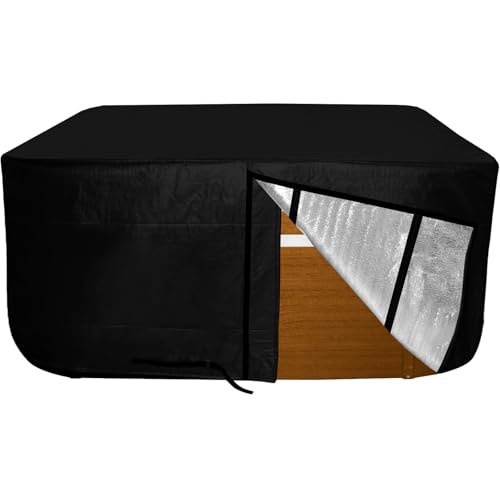
Pros
- Adds full perimeter cabinet coverage with a deep 35-inch side skirt
- Stainless steel D-locks and adjustable straps provide secure anchoring against strong winds
- Dark 170G polyethylene fabric naturally hides tree pollen, bird droppings, and outdoor soil
- Lightweight build makes seasonal installation and removal manageable for one person
Cons
- Does not replace a rigid foam spa cover and must be used over an existing hard cover
- Square 94-inch by 94-inch profile cannot be adjusted for significantly smaller or round hot tubs
- Removing the protector adds an extra step before using the spa compared to operating a cover lifter alone
The YUJHON 94-inch by 94-inch by 35-inch Hot Tub Cover Protector is a specialized exterior spa cap engineered to fit over an existing hard cover and drape down the spa cabinet. This protective jacket is aimed at hot tub owners living in regions with severe winters, high wind exposure, or intense summer sun who want to safeguard their primary vinyl cover from premature wear. Because it covers both the top lid and extends 35 inches down the sides, it offers full-surround coverage for square hot tubs measuring up to 94 inches across. It is particularly relevant for owners seeking to cut down on seasonal weather damage without buying an entirely new hard cover.
Using an exterior cover cap addresses common issues like heavy snow buildup, UV fading, and debris accumulation that degrade primary vinyl covers over time. The integrated side-insulated panels drape over the cabinet sides, helping to reduce perimeter draft and heat escape during breezy or chilly evenings. The dark black exterior serves dual functions: it naturally absorbs solar heat during sunny daytime hours and conveniently hides dust, pollen, and rain marks between cleanings. Spa owners should note that while this protector offers weatherproofing and thermal buffering, it relies on the structural support of a firm, underlying spa cover to prevent water pooling on top.
The cap is fabricated from 170G polyethylene fabric, which provides a flexible yet durable barrier against rain, snow, dust, and animal mess. For wind management, the design incorporates a multi-point closure setup featuring heavy-duty hook-and-loop fasteners, adjustable tensioning straps, and corrosion-resistant stainless steel D-locks. These fasteners work together to anchor the long skirt firmly around the spa base, reducing the flapping, shifting, or blow-offs common with generic, loose tarps. At an overall weight of roughly 2.5 pounds, the fabric remains pliable enough to fold compactly when not in use.
Installation requires draping the fabric protector squarely over the closed hard cover and securing the perimeter fasteners around the spa cabinet. Owners should measure their hot tub dimensions accurately before purchasing, confirming that their shell does not exceed 94 inches in length or width and that the 35-inch height accommodates their cabinet profile. Removing the cover protector before soaking adds an extra operational step, so users with automated cover lifters will need to unbuckle and fold the protector off before swinging the primary cover back. Routine maintenance is straightforward, requiring occasional hose rinsing or spot wiping to keep the dark surface clean.
A critical factor for buyers to understand is that this fabric cap cannot serve as a standalone spa cover; it provides no rigid foam core to support snow loads or prevent submersion on its own. If placed over a sagging, waterlogged, or cupped hard cover, water may still pool in low spots, necessitating manual clearing after rainstorms. Additionally, owners with non-square hot tubs, rounded contours with large radii, or raised cabinet accessories like steps and handrails may need to adjust how the 35-inch skirt drapes.
For owners of square hot tubs up to 94 inches who want an extra layer of defense against seasonal elements and drafty winds, the YUJHON side-insulated cover protector represents a practical, budget-conscious addition to their maintenance setup. It is best suited for homeowners looking to prolong the service life of their primary cover during harsh weather seasons or vacation-rental downtime. Before buying, verify your spa cabinet width and ensure your underlying hard cover is structurally sound to provide the flat surface needed for proper runoff.
The YUJHON spa cover protector is built for square hot tubs measuring up to 94 inches long by 94 inches wide (approximately 7 feet 10 inches square). It features a 35-inch vertical drop designed to cover both the top cover and the exterior cabinet sides.
To ensure proper fit, measure your spa from the widest outer edge of the cabinet on both sides. If your spa measures significantly smaller than 94 inches, excess fabric will bunch at the corners. Additionally, ensure cabinet accessories such as steps or side bars do not obstruct the 35-inch side skirt.
High winds can easily dislodge standard spa tarps, but this protector incorporates a dedicated multi-stage retention system. It features hook-and-loop closures along key adjustment points to gather excess fabric neatly.
For primary retention, adjustable side straps pair with stainless steel D-locks to anchor the lower skirt against the spa cabinet. This hardware helps prevent high-wind uplift, edge flutter, and blow-offs during severe storms.

Pros
- Very lightweight at roughly 3.7 lbs, making it easy for any user to place, remove, and store - a major advantage over traditional heavy covers
- Quick inflate-and-deploy design requires no mounting hardware, lifter, or installation, which suits first-time spa owners and renters
- Helps limit debris entry and heat loss on round inflatable hot tubs, potentially lowering energy costs and reducing filter maintenance
- Compact and easy to deflate for storage or transport, making it practical for seasonal use or vacation-rental operators with inflatable spas
- Affordable entry point for basic spa water protection without the commitment of a rigid replacement cover
Cons
- An inflatable bladder cover does not provide the structural rigidity, insulation thickness, or locking security of a traditional hard foam spa cover, so it should not be expected to match those capabilities
- The manufacturer emphasizes inflating to at least 95% capacity; under-inflation may result in a cover that's too small to properly fit the spa opening, requiring careful attention during setup
- Not designed as a safety barrier and should not be relied upon for child or pet exclusion - it floats on the water surface and does not lock or secure to the spa cabinet
The LFUTARI 4.5 Ft Inflatable Hot Tub Cover is a floating bladder-style lid designed primarily for round inflatable hot tubs. Unlike rigid foam spa covers that sit on top of the spa shell and provide structural support, this cover inflates and rests directly on the water surface. That makes it a fundamentally different product category - it's best understood as a lightweight, portable thermal and debris barrier rather than a traditional spa cover replacement. Buyers looking for a simple, affordable way to keep leaves, bugs, and dust out of their inflatable spa between uses will find this type of cover worth considering.
The listed diameter for this size option is 4.5 ft (with the product dimensions noted as 4'7" round), and the manufacturer states it's compatible with most of their spa hot tub range. A larger 5.4 ft version is also available. One critical detail from the product listing: the cover must be inflated to at least 95% capacity, or the resulting dimensions may be smaller than expected and not properly cover the spa opening. Buyers should measure the interior diameter of their inflatable hot tub carefully before purchasing and compare it against the listed cover size to verify a reasonable fit. Because inflatable spas vary in interior dimensions across brands, don't assume this will fit every 4.5 ft rated tub without checking.
At approximately 3.7 lbs, this cover is dramatically lighter than any rigid foam spa cover, which can weigh 50 lbs or more. That weight advantage is significant for older users, anyone with mobility concerns, or simply hot tub owners who find daily cover removal to be a chore. There's no need for a cover lifter, mounting brackets, or help from a second person. You inflate it, set it on the water, and remove it by hand when you're ready to soak. Deflating and storing it is equally straightforward, which makes it practical for seasonal inflatable spa setups or vacation-rental properties where portability matters.
The manufacturer highlights several functional benefits: debris exclusion, reduced water evaporation, heat retention, and the ability to absorb solar energy to help warm the water. These are reasonable expectations for a floating cover that creates a barrier between the water surface and the open air. However, buyers should keep expectations realistic - an inflatable bladder does not have the foam core, vapor barrier, or insulation construction of a hard cover. Its ability to retain heat overnight or in cold weather will be limited compared to a rigid insulated cover. In mild climates or for short periods between uses, the heat-retention benefit is more meaningful. In cold or snowy climates, this cover alone is unlikely to prevent significant heat loss.
There are some practical limitations to keep in mind. This cover does not lock, strap down, or secure to the spa in any way. It floats on the water and can be displaced by wind, so owners in windy locations may find it unreliable without additional measures. It also provides no structural load-bearing capacity and should never be treated as a safety cover. Families with children or pets should not rely on this product for access prevention. Additionally, as an air-filled bladder, it is more susceptible to punctures than rigid covers, so careful handling around sharp objects is advisable.
For inflatable hot tub owners who want a quick, inexpensive, and lightweight way to keep debris out and reduce some heat loss between soaking sessions, the LFUTARI inflatable cover fills a practical niche. It's especially well-suited for warm-climate users, seasonal spa setups, and anyone who values ease of handling above maximum insulation. Before purchasing, measure your spa's interior water-surface diameter and confirm it aligns with the 4.5 ft listed size. If you need robust insulation, wind resistance, locking capability, or structural support, a traditional rigid spa cover is a better fit for those requirements.
The LFUTARI inflatable cover in this listing is the 4.5 ft diameter option, with the product page noting a 4'7" round dimension. A larger 5.4 ft version is sold separately. Because this is a floating bladder cover, fit depends on the interior water-surface diameter of your hot tub rather than the outer shell dimensions. Measure across the widest point of the water surface inside your inflatable spa and compare it to the listed cover diameter.
The manufacturer specifically warns that inflating the cover to less than 95% capacity may result in dimensions that are too small. This means proper inflation is essential to achieving the listed size. If you have access to a reliable air pump with a pressure gauge, that can help ensure full inflation. Buyers should also note that inflatable hot tubs from different brands may have slightly different interior geometries even when marketed at the same nominal size, so verifying your specific tub's measurements before ordering is a practical step.
As a lightweight inflatable cover, the LFUTARI lid is best suited for mild to moderate weather conditions. In warm, sunny climates, the manufacturer notes it may absorb solar heat and help warm the water, which could be a useful passive benefit. For debris protection in fair weather, it serves its intended purpose well.
In cold climates, heavy rain, snow, or high-wind environments, this type of cover has inherent limitations. It does not have a foam core or rigid structure to provide meaningful insulation in freezing temperatures, and it cannot bear any snow load. Wind can displace a floating cover that isn't secured to the spa. The manufacturer mentions it may help reduce condensation and freezing on the spa edge, but buyers in harsh winter climates should consider whether a rigid insulated cover would better serve their needs. For high-UV environments, there is no specific UV-resistance rating listed, so prolonged direct sun exposure over time may affect the cover material.
Maintaining an inflatable cover is straightforward compared to rigid spa covers. Because it's lightweight and portable, you can easily remove it from the water, rinse it off, and wipe down the surface. There's no heavy foam core to worry about becoming waterlogged over time, which is a common issue with traditional rigid covers.
Owners should inspect the cover periodically for punctures or slow air leaks, especially if it's used frequently or stored in areas where sharp objects could cause damage. Keeping the cover clean and free of chemical buildup from spa water may help extend its useful life. When not in use, deflating and storing the cover in a dry location protects it from unnecessary UV exposure and wear.

Pros
- The 16-mil thickness provides a meaningful upgrade over thinner thermal blankets, giving the material more resistance to tearing during daily removal and replacement
- Trim-to-fit design accommodates slight variations in tub shape and size, so it doesn't need to be an exact factory match to your spa
- Helps protect the main hard cover from excess moisture and condensation, which is a practical benefit for owners dealing with waterlogged or deteriorating covers
- Very lightweight and easy to handle, making it accessible for older users or anyone who doesn't want to wrestle with heavy cover accessories
- Versatile enough for square hot tubs, in-ground spas, and stock tank pools, adding value for owners with multiple water features
Cons
- Manufacturer describes this as a consumable product with a 1-2 season lifespan, so buyers should expect periodic replacement rather than long-term durability
- The 7x7 FT size only suits square or near-square tubs - owners with round, rectangular, or irregularly shaped spas will need to trim significantly or look for a different size
- Chemical exposure from sanitized hot tub water may accelerate material breakdown over time, and the listing does not specify chemical resistance ratings
The Angooni 7x7 FT thermal blanket is a floating insulation layer - not a replacement for your hard cover, but a supplemental barrier that sits directly on the water surface to trap heat and reduce evaporation. This type of product is most useful for hot tub owners who notice long reheat times, rising energy costs, or excessive condensation forming on the underside of their main cover. It's designed for square hot tubs, in-ground spas, and stock tank pools, and at 84 x 84 inches, it provides generous coverage that can be trimmed down with ordinary scissors to match your spa's exact footprint.
The 16-mil thickness is a notable step up from the 8-12 mil blankets commonly found on the market. That extra material thickness translates to better tear resistance during the daily routine of pulling the blanket off before a soak and laying it back down afterward. The air-bubble construction - with the bubble side placed face-down on the water - creates an insulating air gap between the blanket and the water surface. The manufacturer states this design can reduce evaporation by up to 95%, though real-world results will depend on factors like ambient temperature, wind exposure, and how consistently the blanket is used alongside a hard cover.
One of the more practical benefits for many hot tub owners is the protective effect on the main hard cover. By reducing the amount of steam and condensation that rises from the water surface, a thermal blanket like this may slow the moisture intrusion that causes foam cores to become waterlogged over time. For owners in cold or snowy climates who rely on their hard cover for structural protection, pairing it with a floating thermal blanket underneath is a common strategy to extend the cover's useful life and maintain insulation performance through winter.
Setup is straightforward and requires no special tools or skills. The blanket arrives flat, and the manufacturer recommends laying it out to relax any shipping folds before trimming. You simply place it over your tub, mark the edges where it overhangs, and cut to fit. Bubble side goes down on the water. At just 3.74 pounds, the blanket is easy to handle for virtually anyone, including older users or those who already struggle with a heavy main cover. Rinsing with clean water as needed is the primary maintenance step.
The main limitation to keep in mind is that this is explicitly a consumable product. The manufacturer estimates a lifespan of about 1-2 seasons, and prolonged exposure to hot, chemically treated water will gradually degrade the material. Buyers should factor in periodic replacement costs rather than expecting multi-year durability. Additionally, while the 7x7 FT size works well for square tubs, owners with round or non-standard shapes will lose material during trimming and may find the fit less ideal around curves.
The Angooni 7x7 FT thermal blanket is a sensible, low-cost addition for square hot tub owners who want to reduce energy costs, shorten reheat times, and protect their main cover from moisture damage. It's especially worth considering for owners in cold climates who run their spa year-round, as well as budget-conscious households looking for a simple way to improve heat retention without replacing their existing cover. Before purchasing, verify your tub's interior dimensions to confirm the 84 x 84 inch blanket provides adequate coverage for your specific spa.
The Angooni thermal blanket measures 7 x 7 feet (84 x 84 inches) and is designed for square hot tubs, in-ground spas, and stock tank pools. Because it's a trim-to-fit product, the blanket does not need to match your spa's dimensions exactly - it just needs to be large enough to cover the water surface with some overhang for trimming. Measure the interior water surface of your tub before ordering to confirm the 84 x 84 inch size provides sufficient coverage.
Trimming is done with standard scissors. The manufacturer recommends placing the blanket over the tub, marking the edges, and cutting to match your spa's shape. This approach works well for square and near-square tubs. Owners with round or octagonal spas can still trim to fit, but should expect to remove more material and may find it harder to achieve a perfectly snug edge around curves. The blanket is only 0.004 inches thick (16 mil), so cutting is quick and easy.
For hot tub owners in cold and snowy climates, the Angooni thermal blanket is designed to work as a supplemental insulation layer underneath a hard cover. The manufacturer specifically recommends pairing it with a hard cover for best winter results. By floating on the water surface and trapping heat beneath the main cover, the blanket may help reduce the energy required to maintain target water temperature during freezing conditions.
Reducing condensation on the underside of the hard cover is another meaningful benefit in cold climates, where the temperature differential between hot water and cold air accelerates moisture buildup. Over time, this condensation can saturate the foam core of a hard cover, leading to waterlogging and reduced insulation. A floating thermal blanket adds a buffer that may slow this process. Keep in mind that the blanket itself is a consumable item with a 1-2 season expected lifespan, so cold-climate owners who use their spa year-round should plan for at least annual replacement.
Maintaining the Angooni thermal blanket is simple. The manufacturer recommends rinsing it with clean water as needed to remove chemical residue, body oils, and any debris that collects on the surface. No special cleaning products or tools are required. When not in use, the blanket can be stored flat or loosely rolled.
Because the blanket sits directly in chemically treated hot tub water, the material will gradually break down over time. The manufacturer sets expectations clearly by describing this as a consumable cover with an approximate 1-2 season lifespan. Signs that it's time to replace include visible deterioration of the air bubbles, thinning material, tears, or reduced buoyancy. Keeping a spare on hand is a practical approach for owners who rely on the blanket for daily heat retention.

Pros
- Lightweight at under 5 pounds, making daily on-and-off handling simple for most users including older adults or solo spa owners
- Anti-wind straps and zippered closure offer better security than basic draped covers, which is helpful for patios and decks exposed to wind
- Foldable and compact for storage, unlike rigid foam covers that require permanent space or a cover lifter
- Insulation fill may help slow heat loss between soaking sessions, potentially reducing energy costs for inflatable hot tub heaters
- Handles on the cover simplify the process of centering and positioning it over the tub
Cons
- A soft insulated cover like this won't provide the same level of heat retention as a rigid foam hot tub cover - expect it to slow heat loss rather than eliminate it
- The 85-inch diameter may not match every inflatable hot tub precisely, so measuring your spa's outer diameter and height before purchasing is essential
- Soft covers generally aren't designed to support snow loads or stand up to heavy accumulation the way rigid covers can, which is a consideration for cold-climate owners
The Tlswshsy 85x27-inch round insulated thermal cover is a soft, zippered cover designed specifically for round inflatable hot tubs. Unlike rigid foam spa covers used on permanent acrylic spas, this is a lightweight fabric cover filled with silk wadding insulation that drapes over and around an inflatable tub. It's best suited for owners of round inflatable hot tubs from brands like Intex, Coleman, Bestway, or similar setups who want something more protective than the basic inflatable lid that ships with most portable spas. Couples, families, first-time spa owners, and vacation-rental operators running inflatable hot tubs on patios or decks are the clearest audience for this type of cover.
The listed 85-inch diameter and 27-inch height define the coverage area, so buyers need to measure their inflatable tub's actual outer diameter and wall height before ordering. A cover that's too small won't close properly, and one that's too large will sag and collect water or debris. The zippered closure is a meaningful feature because it allows the cover to wrap securely around the tub rather than simply sitting on top. Combined with the listed anti-wind straps, this design may help keep the cover in place during moderate wind - a real concern for anyone using an inflatable spa on an open patio, rooftop deck, or in a location prone to gusts.
Build quality on a soft thermal cover like this centers on the outer fabric and the insulation fill. Tlswshsy lists the outer material as resistant to rain, moisture, and direct sunlight, though no specific fabric type, denier rating, or UV-resistance certification is provided. The silk wadding insulation is intended to create a thermal barrier between the outside air and the water surface. This type of insulation can help slow heat loss, especially in mild to moderately cool conditions, but it won't match the R-value or heat-retention performance of a thick rigid foam cover. For inflatable hot tub owners who typically deal with lower water temperatures and smaller heaters, even modest insulation can help reduce energy consumption and keep water warmer between uses.
Setup is straightforward based on the listed design. The cover weighs just under 5 pounds, so a single person can easily position it over the tub, zip it closed, and secure the anti-wind straps. Handles on the cover make centering and removal simple. When the tub isn't in use seasonally, the cover folds down compactly for garage or closet storage - a significant advantage over rigid covers that demand dedicated space or a cover lifter. For daily use, the light weight means there's no heavy lifting involved, which is a practical benefit for older users or anyone who soaks frequently and doesn't want to wrestle with a bulky cover every time.
There are realistic limitations to consider. Soft insulated covers like this are not structural - they won't support snow accumulation, heavy rain pooling, or any weight. Owners in snowy climates should be aware that snow will need to be cleared regularly, and standing water on the cover surface could stretch or stress the fabric over time. The insulation value, while helpful, is modest compared to rigid foam alternatives with vapor barriers. Additionally, long-term UV exposure may degrade the outer fabric over multiple seasons even with listed sun resistance, so owners in high-UV climates like the Southwest may see shorter cover life.
This Tlswshsy thermal cover is a practical, affordable option for round inflatable hot tub owners who want better debris protection and heat retention than a basic inflatable lid provides. The zippered closure, anti-wind straps, and lightweight handling make it easy to live with daily. Before purchasing, measure your inflatable tub's outer diameter and wall height carefully and compare them to the listed 85x27-inch dimensions. If your tub falls within that size range, this cover fills a real gap between the flimsy stock lids and the rigid covers that don't fit inflatable spas.
The Tlswshsy round thermal cover lists dimensions of 85 inches in diameter and 27 inches in height. These measurements define the maximum tub size the cover can accommodate. Before ordering, measure your inflatable hot tub's outer diameter at its widest point and the height from the ground to the top rim. A snug fit ensures the zipper closes properly and the anti-wind straps can secure the cover effectively. If your tub is significantly smaller than 85 inches, the excess fabric may pool or sag, which could collect rainwater or debris on top of the cover.
Keep in mind that inflatable hot tubs can vary in diameter depending on inflation level and water fill. Measure your tub when it's fully inflated and filled to its normal operating level for the most accurate comparison. The 27-inch height measurement should cover the full wall height of most standard inflatable spas, but taller models or tubs placed on raised platforms may not be fully covered. If you're between sizes or unsure, contacting the manufacturer with your specific tub dimensions before purchasing is a smart step.
Wind is one of the biggest practical challenges for inflatable hot tub covers, and the Tlswshsy cover addresses this with two features: a zippered closure and anti-wind straps. The zipper allows the cover to wrap around the tub and close securely rather than simply resting on top where a gust could lift it. The anti-wind straps add a secondary attachment point to help keep the cover anchored during breezy conditions.
For owners using inflatable spas on open patios, elevated decks, or in regions with frequent wind, these features offer a meaningful advantage over basic draped covers. However, no soft cover can be considered fully windproof in extreme conditions. In areas with strong sustained winds or severe weather, additional securing methods like weighted objects at the base or positioning the tub in a more sheltered spot may be worth considering alongside the cover's built-in straps.
The silk wadding insulation in this cover is designed to help retain water temperature in cooler weather. For inflatable hot tub owners in mild to moderately cold climates, this insulation layer can help reduce how quickly heat escapes through the water surface, potentially lowering energy costs by reducing heater run time. The full-coverage zippered design also limits cold air from reaching the water compared to a loose-fitting lid.
However, owners in regions with heavy snow, freezing temperatures, or extended cold seasons should understand the limitations of a soft insulated cover. This type of cover cannot support snow weight and does not provide the same thermal barrier as a rigid foam cover with a sealed vapor barrier. Snow should be cleared promptly to avoid stretching or damaging the fabric. For extreme cold-climate use, this cover may work best as a supplemental layer over the tub's stock lid rather than as the sole thermal barrier.

Pros
- Custom dimension sizing up to 8x8 feet ensures a proper perimeter seal when accurate measurements are supplied.
- Tapered foam structure facilitates natural drainage of precipitation and melting snow to reduce standing puddles.
- Vapor-wrapped foam cores are designed to minimize moisture absorption and slow down cover weight gain over time.
- Integrated locking safety straps and reinforced handles assist with secure closure and daily spa access.
Cons
- Exact measurements must be verified prior to ordering, as custom-made covers cannot simply be exchanged for a standard off-the-shelf size.
- The standard package uses medium-density foam, requiring an optional upgrade for those needing heavy 2-pound high-density foam in severe snow zones.
- Regular vinyl cleaning and UV conditioning are still required to keep the exterior marine-grade material pliable and clean.
The Cover Guy Custom Replacement Hot Tub Cover is designed for spa owners dealing with an old, waterlogged, or deteriorating lid that no longer seals heat effectively. Tailored to the specific dimensions of your hot tub, this replacement hard cover suits homeowners, vacation rental managers, and families looking for a snug fit on square tubs up to 8 by 8 feet. Instead of settling for a generic cover that leaves drafty gaps around the rim, ordering a custom-dimensioned unit helps maintain proper perimeter contact across your acrylic shell or cabinet top.
Heat containment and weather resistance are central to how this replacement cover functions in changing outdoor conditions. The cover features a sloped design with 6-inch, 5-inch, or 4-inch taper configurations that direct rainwater, sleet, and melting snow away from the center fold. Combined with marine-grade vinyl and a listed insulation rating of R19, the tapered foam core helps trap heat inside the spa water and reduce heat loss during chilly evenings or seasonal cold snaps.
Internal water absorption is the most common reason spa covers fail, and this model addresses moisture accumulation with a specialized protective wrap around the foam cores. Marketed with zero water absorption technology, the vapor barrier is engineered to block rising steam and moisture vapors from soaking directly into the interior foam. Marine-grade vinyl exterior construction, reinforced lifting handles, and durable perimeter stitching provide the structural durability needed to withstand continuous outdoor UV exposure and regular spa use.
Daily operation is straightforward thanks to an estimated 45-pound baseline weight that reduces the physical strain of opening and closing your hot tub. Reinforced straps with child-resistant safety locks help anchor the cover down against sudden wind gusts while supporting standard residential spa safety expectations. The center hinge configuration folds smoothly, making it compatible with manual handling or integration into most standard cabinet-mounted cover lifters that accept hard folding covers.
While a custom-fit cover provides an excellent seal, it places the responsibility of precise measurement entirely on the buyer before ordering. Because the cover is made to order with an allowable tolerance of plus or minus 0.5 inches, measuring your spa shell width, length, and corner radius accurately is critical to avoid overhang or undersized edges. Additionally, spa owners in areas with extreme, heavy snowfall may want to consider upgrading to the manufacturer-listed 2-pound high-density foam core to handle heavier seasonal snow loads.
For hot tub owners seeking to restore energy efficiency, lower heater cycle times, and replace a heavy, water-soaked lid, The Cover Guy Custom Replacement Hot Tub Cover offers a practical and protective upgrade. Its blend of marine vinyl, tapered water-shedding geometry, and a 3-year manufacturer warranty delivers dependable everyday performance. Before purchasing, take double-checked measurements of your tub outer dimensions and corner radius to ensure your custom order fits your cabinet seamlessly.
To ensure your replacement cover fits properly, measure the outside dimensions of your spa shell or acrylic lip rather than your old, warped cover. For square or rectangular spas, record the exact length and width, keeping in mind the manufacturer tolerance of plus or minus 0.5 inches on the finished build.
Check your corner radius carefully using a carpenter square or straight edge against the curve of the spa corner. An accurately measured corner radius ensures the cover skirt drapes smoothly over the cabinet corners without bunching, stretching, or leaving unsealed gaps where heat can escape.
The cover is built around an insulated foam core featuring a listed R19 thermal rating designed to reduce thermal loss from your spa water. By maintaining a continuous barrier against escaping heat, the cover helps reduce the runtime of your hot tub heater throughout colder months.
The foam is tapered across a 6, 5, or 4-inch slope to promote natural drainage of rain and melting snow toward the perimeter. For owners in regions that experience severe winter snow accumulation, the manufacturer offers upgrade options to higher-density 2-pound foam with a 6-to-4 inch taper to provide added structural firmness under seasonal weather loads.
Waterlogging is the primary cause of spa cover degradation, occurring when rising hot tub steam gradually penetrates into the raw foam core. The Cover Guy addresses this issue by wrapping the interior foam with a protective vapor barrier designed to limit moisture intrusion and delay the heavy water weight gain that plagues aging covers.
Keeping your spa water balanced and maintaining proper chemical levels further protects the underside vapor barrier and marine vinyl from premature chemical damage. Periodically ventilating your hot tub after shock treatments will help extend the effective service life of both the vapor wrap and the vinyl exterior.

Pros
- Custom built to exact spa dimensions up to 96 by 96 inches, including multiple corner radius choices.
- Tapered EPS foam core encourages rain and melting snow runoff to help prevent water pooling.
- Available in both classic 30 oz marine-grade vinyl and lightweight, durable HydroTex 600D fabric.
- Includes protective moisture wrap around the virgin foam core to resist premature water absorption.
- Backed by a solid 5-year warranty on HydroTex 600D or a 3-year warranty on marine vinyl.
Cons
- Requires careful and accurate user measurements before ordering, as custom covers cannot simply be adjusted after manufacturing.
- Protective foam wrapping resists moisture but does not permanently eliminate the risk of eventual vapor intrusion over long-term ownership.
- At an estimated weight around 60 pounds for larger builds, solo daily removal without a cover lifter can feel cumbersome.
The MySpaCover Custom-Made Spa Cover is a made-to-order hard thermal replacement designed for hot tub owners facing deteriorated, waterlogged, or cracked factory covers. Sized for spas up to 96 by 96 inches across square, rectangular, and specialty footprints, it caters to homeowners, rental managers, and cold-climate spa users who require a precise perimeter seal. Replacing a compromised cover is essential for locking in water heat and protecting the acrylic shell from outdoor exposure.
Accurate dimensional fit serves as the foundation of thermal retention and debris protection on any hot tub. MySpaCover fabricates each unit to within plus-or-minus one-half inch of specified measurements, accommodating five distinct corner radius options to match rounded acrylic shells. The built-in foam taper ensures rainwater and melting snow run off the edges rather than collecting into heavy center puddles that can strain the core over time.
Material selection lets buyers tailor the cover to their specific regional weather conditions. Hot tub owners can pick between traditional 30 oz marine-grade vinyl or modern HydroTex 600D fabric, both sewn with reinforced double-stitching along the main stress zones. Beneath the outer jacket, high-density virgin EPS foam delivers dependable thermal insulation, encased in a sealed protective wrap engineered to resist vapor intrusion and delay moisture uptake.
Ordering and managing a custom spa cover requires taking precise measurements of the outer acrylic rim rather than relying on an old, deformed cover that may have sagged or shrunk over time. With a listed shipping weight around 60 pounds for sizable units, pairing the cover with a cabinet-mounted or under-mount cover lifter makes daily opening and closing far more manageable for couples and solo users. Routine upkeep involves rinsing dirt and outdoor debris from the surface and using mild cleaners suited for vinyl or fabric to protect the exterior against intense sun exposure.
While the sealed core helps resist moisture intrusion, hot tub owners should recognize that no thermal foam core is entirely immune to gradual waterlogging over extended years of continuous steam exposure. In addition, because each cover is custom-manufactured to user-supplied dimensions, inaccurate corner radius or shell measurements can result in poor heat sealing or improper skirt overhang. Users in regions with high winds will also need to ensure tie-down straps are correctly positioned and secured to prevent wind lift.
The MySpaCover replacement is an excellent investment for spa owners ready to replace an aging, waterlogged cover with a properly insulated, tailored thermal barrier. Before placing an order, measure your hot tub shell twice with a carpenter square to confirm corner radius, overall length, and width to ensure a snug, energy-saving fit right out of the box.
Taking exact measurements is the most critical step when ordering the MySpaCover replacement. Always measure the exterior dimensions of your hot tub acrylic shell rather than an old cover, as aged covers frequently bow, sag, or shrink from sun and water exposure.
This custom cover supports square, rectangular, and specialty spa designs up to 96 by 96 inches. MySpaCover offers five distinct corner radius choices and manufactures each cover to within a tight plus-or-minus half-inch tolerance. Using a carpenter square or a two-ruler method along the rounded corner of the spa shell will give you the precise radius needed for a tight thermal seal.
The core of this replacement cover is constructed from virgin high-density EPS foam, which creates a stable thermal blanket across the entire surface of your spa water. By slowing passive heat loss between soaking sessions, the dense foam reduces how frequently your spa heater cycles on, helping to manage monthly electricity expenses.
To protect the insulation, the foam core is wrapped in a protective vapor seal designed to shield the porous EPS material from steam and chemical vapors. In addition, the foam is cut with a deliberate taper that slopes outward, encouraging rain and melting snow to shed naturally instead of pooling in the center.
Hot tub owners can select between heavy 30 oz marine-grade vinyl and HydroTex 600D fabric depending on their climate and aesthetic preferences. Marine vinyl offers traditional heavy-duty weather resistance, while HydroTex 600D provides strong UV resistance with reduced fabric weight.
All seams are finished with reinforced double-stitching to resist wind stress and repeated folding at the center hinge. The HydroTex 600D material includes an industry-leading 5-year warranty, while the marine vinyl option carries a 3-year warranty against manufacturing and material defects.
Frequently Asked Questions About Spa Covers
How do exact spa measurements affect the fit of a foldable hot tub cover with insulated cooler?
Precise shell measurements determine whether the cover creates an airtight thermal seal or leaks heat into the surrounding yard. A cover matching outer cabinet dimensions prevents perimeter drafts and stops rainwater from pooling on sagging sections. Skirt overhang must drape cleanly over the acrylic lip to block wind without bunching against side panels.
What causes spa covers to become heavy and waterlogged over time?
Punctured or degraded vapor barriers allow steam and chemical moisture to seep directly into the inner foam core. Once the foam absorbs evaporated water, insulation value drops and the extra physical weight strains spa hinges. Examining lightweight hot tub cover for outdoor concerts and portable setups demonstrates how protected moisture barriers keep total weight manageable over years of outdoor exposure.
Can an inflatable bladder or thermal blanket replace a traditional hard foam spa cover?
Inflatable bladder lids and floating thermal blankets serve as secondary heat-retention aids rather than standalone replacements for structural hard covers. Floating blankets reduce water surface evaporation by up to 95 percent, while inflatable inserts create a dome that sheds rainwater and snow. Pairing an inflatable dome under an existing lid or considering a swivel hot tub cover under 30 dollars provides an affordable way to boost winter heat retention.
Does corner radius matter when ordering a replacement spa cover?
Corner radius measurements dictate whether a square or rectangular cover sits flush against the tub rim or overhangs awkwardly. An incorrect radius leaves gaps at curved edges where warm air escapes and blowing leaves enter the spa water. Measuring the curve using a carpenter square ensures the manufactured corners contour cleanly along your hot tub shell.
How do windproof straps and locking buckles protect hot tub covers in 2026?
Adjustable tie-down straps with locking buckles anchor the cover firmly against the spa cabinet to prevent storm lift-off and perimeter air gaps. Tightening the perimeter hardware pulls the insulated skirt flush against the spa walls, sealing in heated moisture while locking out dirt. Locking clips also provide reliable peace of mind by stopping unauthorized access when the hot tub remains unattended outdoors.


Write Your Review
No reviews yet. Be the first to share your experience!